


The perceived threat from Russia in G7 countries in 2025 fell to 8th place, after rising to second place in 2024 from fourth the previous year, according to the 2025 Munich Security Index (MSI) results published Tuesday.
“Although Russia is still considered a significantly greater risk than in 2021, the perception of the severity of the risk associated with it has decreased in all surveyed countries since last year’s survey, including among G7 countries,” the report states.
The largest changes were recorded in the U.S. and Canada, where Russia is now ranked 15th, compared with second place the previous year.
For UK citizens, the perceived Russian threat fell to third place from first, in Germany to fourth from second, in France to sixth from fourth, and in Italy from 12th to 13th. Only citizens of Japan retained their ranking, keeping Russia in fourth place.
Meanwhile, in China and India, Russia ranks second and first from the bottom of a list of 32 risks, respectively; in Brazil and South Africa, it ranks fifth from the bottom, up from ninth the previous year.
Over the year, Russia’s negative rating improved from 20.9% to 18.0%, while Ukraine’s positive rating fell from 32.6% to 28.3%.
The report notes that reflecting current U.S. foreign policy events, respondents in almost all G7 and BICS countries—except Japan and China—now perceive the United States as a more serious threat than last year.
Moreover, the risk posed by trade wars is now seen as much more serious than last year and ranks higher than ever in G7 and BICS countries: in the G7 it rose to 7th place from 21st, and in BICS to 10th from 21st.
“Amid numerous dramatic political and economic crises dominating the global agenda, environmental risks are now perceived as less inevitable. Although the actual costs of global warming are rapidly increasing, the share of respondents viewing extreme weather, wildfires, and climate change as inevitable risks to their country has declined in G7 and BICS countries since the first MSI edition in 2021, reaching a new low in 2025,” the report states.
Nonetheless, respondents in BICS countries continue to regard environmental risks as the main risks for their countries—a trend unchanged since 2021. In contrast, in G7 countries, environmental risks have gradually declined in the rankings in recent years, while cyberattacks, economic or financial crises, and disinformation campaigns by adversaries have come to be considered the most serious risks.
Overall, in most countries, the majority of risks are perceived as less serious than last year. However, the opposite trend is observed in the UK, the U.S., and India, where more risks are now considered more serious than last year. In the United States, there is a particularly pronounced increase in perceived severity of risks related to the country’s economic and political situation, such as food shortages, democratic collapse, rising inequality, economic or financial crises, civil war or political violence, as well as trade wars.
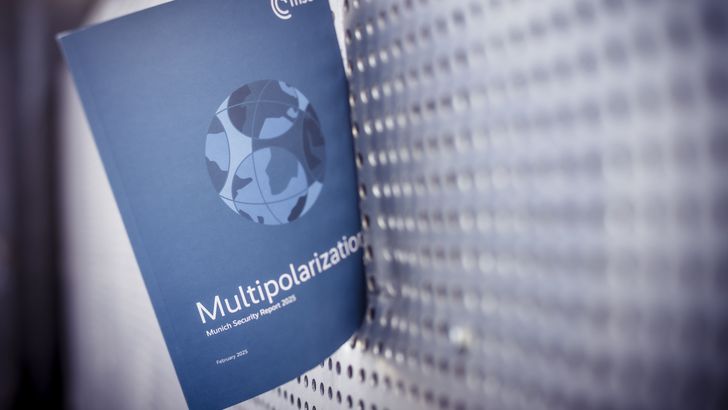
The Munich Security Index is compiled by the Munich Security Conference (MSC) in partnership with Kekst CNC. The survey, conducted from November 5 to 25, 2025, included 1,000 respondents from each country. Russia was excluded from the survey in 2022, but it was conducted in Ukraine.