

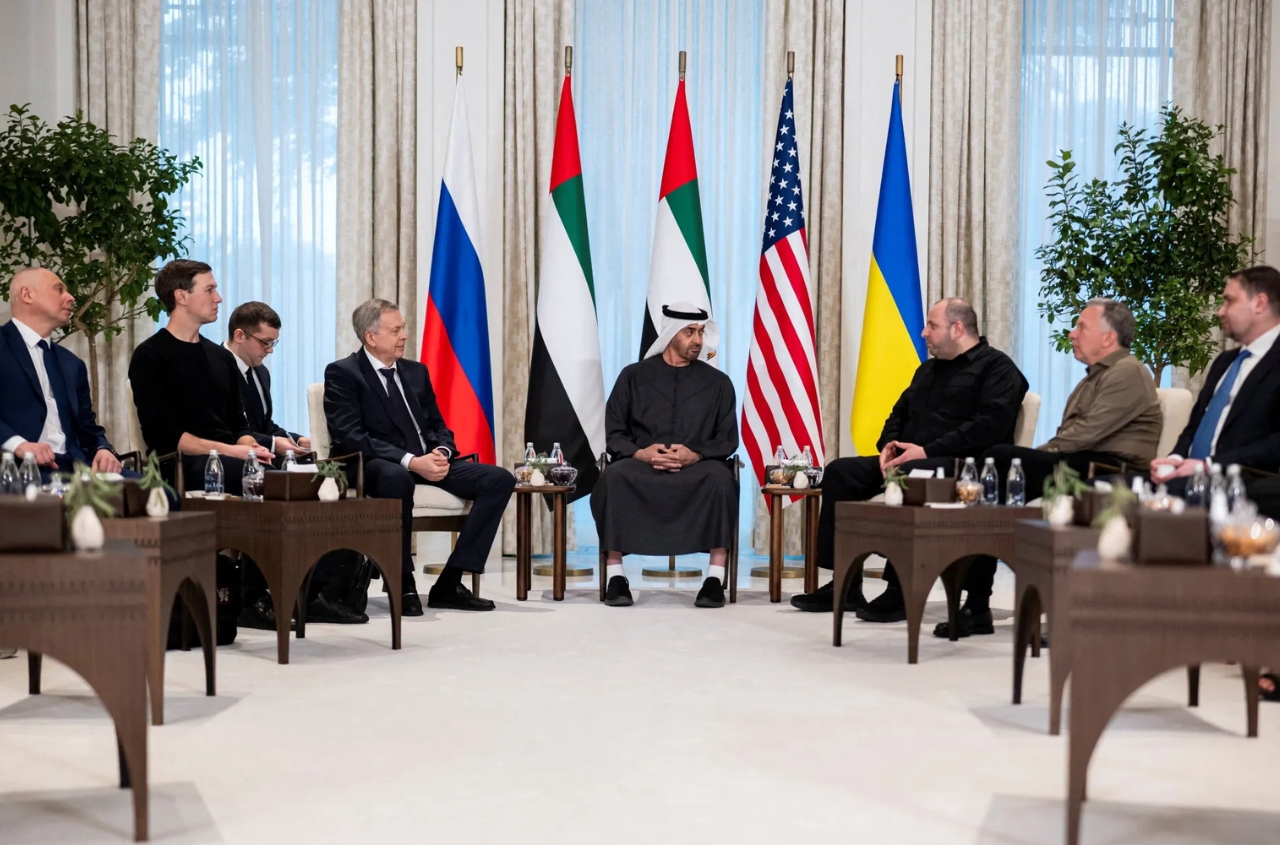

My interpretation of what is happening in the negotiations in the Emirates can be summed up with a saying that was popular in my youth: “It’s very hard to find a black cat in a dark room, especially if it isn’t there.” The black cat represents the willingness to reach an agreement. And it isn’t there—on either side. But there is a need for it—an objective one—and there is Trump, an unexpected subjective factor (a black-and-white swan, whom no one invited, but who flew in on his own and made a mess for everyone). Therefore, I admit that at some point, they might even “find” a cat that isn’t there. It happens, especially if those searching are locked in a room without light, heat, or water for a long time. At least, that’s what Trump seems to think, philosophically reacting to Russian strikes on Ukraine’s urban infrastructure.
It seems to me that Ukraine and Russia are conducting different negotiations in Abu Dhabi. Russia is negotiating for an end to the war on its own terms, while Ukraine is negotiating for a ceasefire on its own terms. Positions are only converging along the narrow strip where these two negotiation spaces intersect—that is, on the technical aspects of the ceasefire. But for Ukraine, the technical details of a ceasefire are the only essential question worthy of discussion, whereas for Russia, this is an abstract matter of no real significance.
For Russia, the ceasefire procedure only matters in the context of ending the war. In my view, this issue is not only unresolved in Abu Dhabi, it is not being discussed at all—following the principle of “you don’t talk about the rope in the house of the hanged.” The “rope” here is the actual terms of a peace treaty, not a temporary ceasefire. Thus, politically, the Abu Dhabi negotiations are essentially just an advanced version of the Istanbul talks. Of course, discussing the technical ceasefire is better than reviewing the history of the Pechenegs, but it doesn’t change the essence: political questions are resolved elsewhere and by different actors.
And while Ukraine is quite constructive in the technical sphere (which aligns with its interests), it is just as politically destructive as Russia, simulating a willingness for peace. On one hand, the political class—which still strongly shapes the general mood of Ukrainian society—grows more confident as spring approaches (just like in the old Kyiv joke: “how long can this winter last?”). On the other hand, Zelensky is trying to turn the final phase of the negotiation process into a show, proposing an inherently unfeasible personal meeting with Putin (they already met in Paris in 2019—the Russian got enough of that). The issue isn’t that this is a form of political theater (this is actually in Trump’s spirit), but that in doing so, Zelensky blocks discussion of war termination terms on platforms other than Abu Dhabi.
The process has reached yet another tactical deadlock (as in Istanbul): when the negotiations shift to discussing prisoner exchanges, it usually means there is nothing else left to negotiate. At the root of this diplomatic deadlock lies Ukraine’s conviction that its ability to pursue a ceasefire instead of an unjust and humiliating peace has not been exhausted. The parties cannot escape this deadlock on their own without a new, strong external impulse from Trump. Moscow calls on Trump to strike Zelensky, while Zelensky demands that Trump ignite Russian oil. All of this causes the “Anchorage spirit” to agonize, and no “Dmitriev injections” can revive it for now.
I think that when the “Trump pendulum” again leaves the Middle Eastern theater, we should expect some sort of “moment of truth” regarding the war in Ukraine, connected to a new additional impulse from Washington. Or, conversely, to its absence…