

Over the past few days, the Russian forces have suffered setbacks of varying severity along key sectors. In some places, the situation was gradually turned around after lengthy preparations; elsewhere, it changed after a sudden series of hard-hitting strikes.
In this context, there is a great temptation to put something dramatic like “turning point on the front” in the headline. But there is no need to rush such things, nor is there any need for excessive optimism.
I would put it more cautiously: on the main axes, the Russian offensive has been disrupted, and there have been effective counterattacks.
And these are key axes for Russia’s objectives, united by one common strategic task: the complete occupation of the Sloviansk-Kramatorsk agglomeration. Russia’s plans have been disrupted — at the very least, this can already be stated with 100% confidence.
The strategic plan to capture the agglomeration did not involve frontal assaults on Kramatorsk. Russian forces planned to partially encircle it and cut two main logistical arteries. In the north, the Sloviansk-Kharkiv highway, which they planned to reach by breaking through from Lyman or Sviatohirsk. In the west, they planned to capture Dobropillia and continue the offensive towards Novooleksandrivka and Barvinkove.
Encirclement, the collapse of logistics — a catastrophe for the Armed Forces of Ukraine, with the loss of Donbas not even being the biggest problem. On paper, everything looked simple, just as it did in 2022.
Problems with implementing the plan immediately emerged in the Lyman sector. The Third Army Corps’ Operation Vivaldi, brilliant in both preparation and execution, turned the situation in the opposite direction. The deployment of robotic systems behind Russian lines, the successful work of air defence and electronic warfare that made it possible to blind Russian forces — all of this led to a complete failure.
Blind, with poor communications and drowning in the lies of victorious reports sent up the chain of command, Russian forces became disoriented. With minimal losses and under complete information silence, the Third Army Corps methodically drove Russian forces from their positions.
Three thousand were eliminated during the first stage, with many others wounded and captured. The counteroffensive continues. So much for a Russian breakthrough towards the highway. The question now is how far they will ultimately have to retreat.
The offensive towards Dobropillia also failed. Several rapid strikes by the well-prepared 1st Azov Corps of the National Guard, followed by a tough clearing operation, came as a shock to Russia’s Centre Group of Forces.
They had spent practically the entire summer infiltrating this territory, building up reserves and preparing for an offensive. Then came the strike, and Azov special forces began dragging them out of their holes.
Russian forces had an enormous advantage in manpower, as well as large numbers of drones and equipment. They could not imagine that, under these conditions, Azov was capable of anything other than a difficult defence.
Instead, they were hit unexpectedly — simultaneously at all their weak points.
The offensive towards Dobropillia has been disrupted, as has the attempt to encircle Druzhkivka and advance towards Kramatorsk.
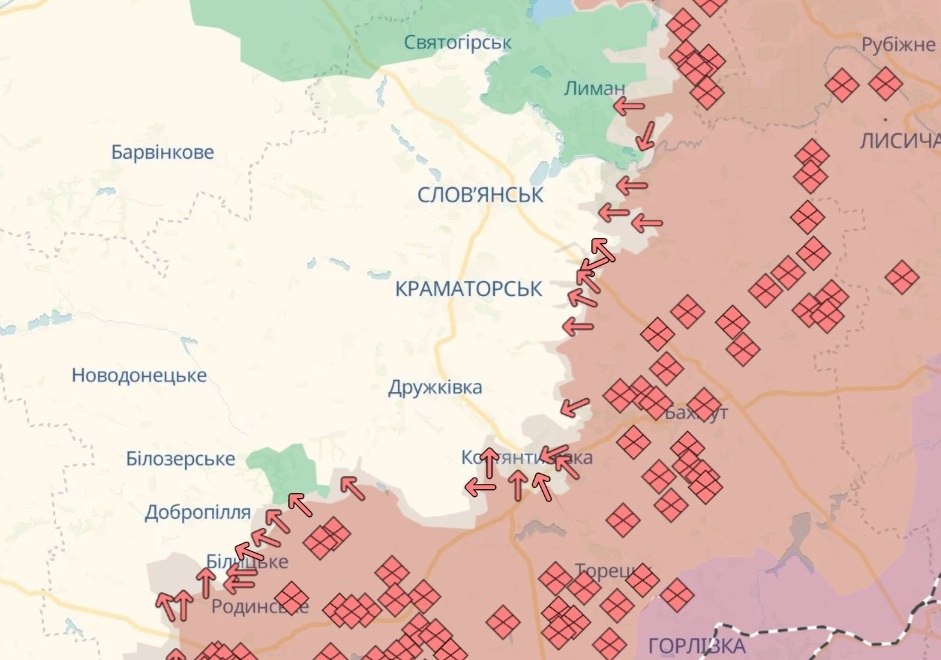
This is what the overall picture now looks like on the two main axes of one large Russian operation, “Occupation of Donbas by the New Year.”
Ukraine held the defensive for a long time, but in fact used this pause to prepare a powerful counterattack. Add to this a series of strikes by Ukrainian airborne forces near Huliaipole.
The autumn operation in Donbas is developing. But it is not Russian forces that are conducting it. Sheep are not invited to a barbecue — they simply take part in it.