

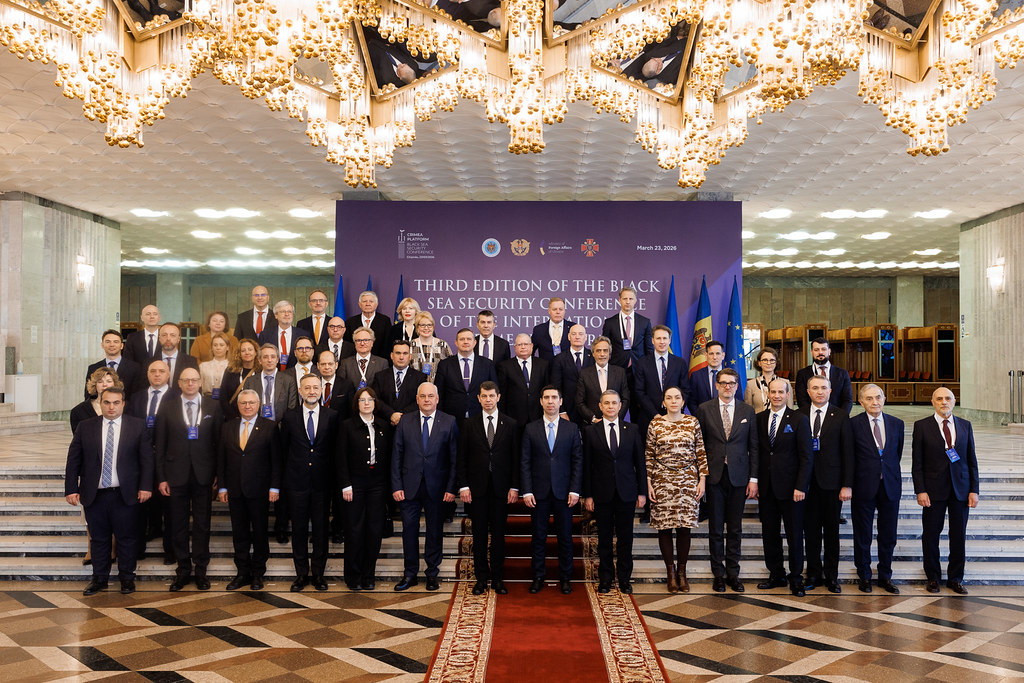
On 23 March, the Third Black Sea Security Conference of the International Crimea Platform took place in Moldova, bringing together representatives of governments, international organisations, the expert community, and the security and defence sector. Participants discussed key security challenges in the Black Sea region, the consequences of Russian aggression, and ways to strengthen regional cooperation.
Opening remarks were delivered by the Minister of Foreign Affairs of Ukraine, Andrii Sybiha; the Minister of Foreign Affairs of the Republic of Moldova, Mihai Popșoi; the Minister of Defence of the Republic of Moldova, Anatolie Nosatîi; and the Secretary General of the Black Sea Economic Cooperation, Lazar Comănescu. Video addresses were also delivered by the Vice-President of the European Commission and High Representative of the European Union for Foreign Affairs and Security Policy, Kaja Kallas, and the European Commissioner for Enlargement, Marta Kos.
In his speech, Ukraine’s Foreign Minister Andrii Sybiha emphasised that Black Sea security is key for Europe and the world, highlighting Russia’s systemic use of the region as an instrument of pressure. At the same time, the Minister noted Ukraine’s ability to change the situation and called for stronger international actions, sanctions, and the de-occupation of Crimea as a prerequisite for a stable peace.
“We must restore peace and return freedom of navigation in the Black Sea. The Black Sea must once again become a sea of peace and security, with secure maritime routes and functioning supply chains restored. Today, however, it has become a sea of Russian war,” Andrii Sybiha emphasised.
The event continued with the first panel discussion, “Reviewing the recent developments in the Black Sea security environment. Evaluating the functioning of the Black Sea corridor to Ukrainian ports as a vital economic lifeline”, during which participants discussed key aspects of the security environment and the role of the grain corridor as a critical element of Ukraine’s economic resilience.
Permanent Representative of the President of Ukraine in the Autonomous Republic of Crimea Olha Kuryshko spoke during the panel. She addressed human rights violations in temporarily occupied Crimea, specifically political persecution, the use of torture, restrictions on freedom of religion, and the deterioration of the environmental situation. She also drew attention to the militarisation of children and youth.
“Children in Crimea are under the influence of propaganda from primary school. They are taught the full cycle of drone operation, which indicates the targeted involvement of youth in the war.”
The second panel discussion — “Addressing risks related to the maritime security and freedom of navigation in the Black Sea, particularly those caused by Russian aggression, and seeking practical responses, enhancing among Black Sea littoral states” — was dedicated to threats to maritime security and shipping stability. Speakers discussed the effectiveness of the Black Sea corridor amidst constant attacks, its significance for global food security, and the need for stronger international support.
During the panel, Yevhen Demchenko, an officer of the Naval Forces of the Armed Forces of Ukraine, emphasised that the effectiveness of the Black Sea corridor should be assessed taking into account the constant security threats Ukraine faces. He highlighted that Russia systematically attacks port infrastructure and shipping using missiles and drones, which are constantly being upgraded.
“Despite enormous pressure and constant attacks, Ukraine has managed to restore the operation of the corridor and even increase export volumes. This proves that we remain a reliable partner capable of ensuring the security of navigation even under such conditions.”
During the third panel discussion, “The strategic importance of Black Sea security as the foundation of European maritime strategy and an element of European security architecture: regional cooperation and collaboration”, participants discussed the Black Sea region’s role in shaping European security architecture. Specifically, they addressed the need to enhance resilience against military, economic, and hybrid threats and to develop effective cooperation mechanisms. They also stressed the importance of energy security, protection of critical infrastructure, and economic interaction for long-term stability.
The fourth panel discussion — “Ensuring maritime security through regional cooperation and capacity-building within existing security frameworks including through exchange of experience of implicating advanced technological devices in the modern warfare” — was dedicated to implementing innovative approaches in the security sector.
Participants discussed scaling up the Ukrainian experience in using maritime drones, integrating unmanned technologies into deterrence strategies, and developing the region’s defence capabilities.
Oleksandr Kylchytskyi, a representative of the Security and Defence Forces of Ukraine, emphasised the need to adapt training for European military personnel to the realities of modern warfare, highlighting Ukraine’s readiness to share its combat experience with partners. According to him, practical experience determines the effectiveness of military units and is a key factor in countering modern threats:
“Ukraine is ready to share its achievements and knowledge, which are written in the blood of our soldiers.”
The Third Black Sea Security Conference of the International Crimea Platform reaffirmed its role as an effective platform for consolidating international efforts — from a shared understanding of security challenges to the development of practical solutions to support Ukraine, strengthen security in the Black Sea region, and shape a resilient European security architecture.