

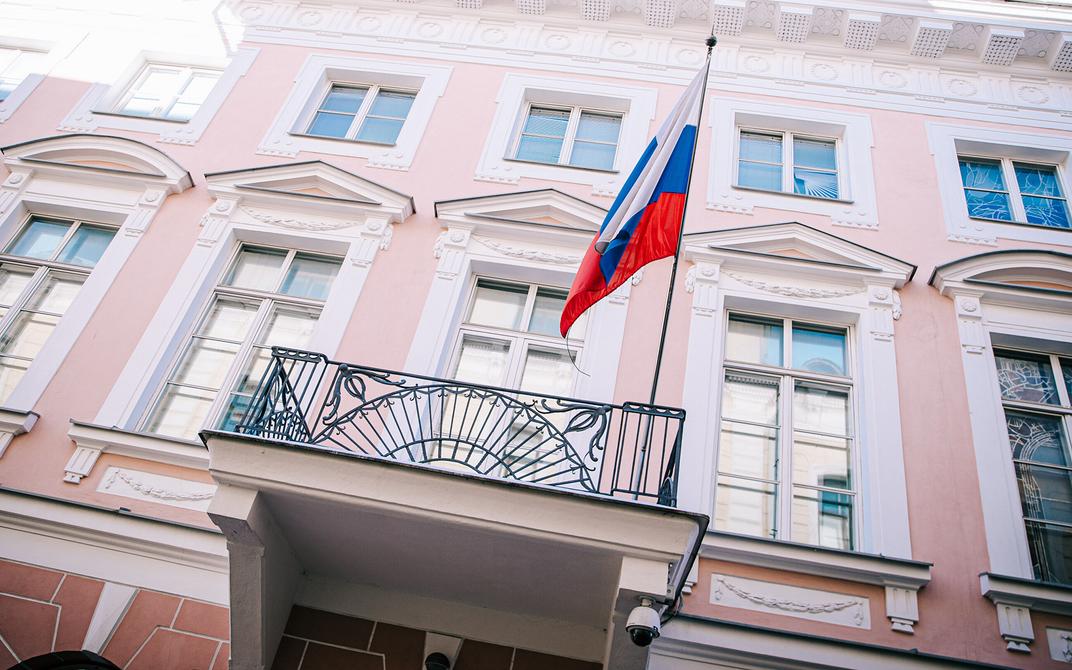

Main image: Russian Embassy in Tallinn. Source: Ken Mürk/ERR
Russia continues to strengthen its ties with African countries by sending officials to the continent who can no longer be assigned to work in Western countries.
According to ERR, this was reported by Estonian foreign intelligence in its latest report.
The report notes that the Kremlin has diversified its activities on the continent and is preparing for the third Russia–Africa summit, scheduled for 2026. Alongside traditional military cooperation, Moscow is increasingly interested in promoting its soft power, such as education and culture. More African students are studying at Russian universities, and agreements have been signed with Chad, Eritrea, Djibouti, and Guinea.
The intelligence report states that Africa will continue to be important for Russia, and the country “will continue its efforts to deepen cooperation with African states.” This cooperation helps, in particular, to “solve an internal problem”—where to send civil servants such as diplomats, intelligence officers, cultural workers, and influence agents who can no longer be posted to the West.
Over the past decade, Western governments have expelled large numbers of Russian diplomats and closed many consulates due to Russia’s secret operations and the war in Ukraine.
“The Russian federal agency ‘Rossotrudnichestvo,’ which plays a key role in influence operations, is becoming increasingly active in Africa, opening offices, including in Guinea and Burkina Faso. In addition, the ‘Russkiy Mir’ Foundation, which promotes the Russian language abroad, has expanded its activities by opening new centers in Burundi and Uganda,” the report states.
Moscow seeks to persuade Africans of its own narratives and spread anti-Western messages, including claims that cooperation with Western countries in Africa is “neo-colonial, unfair, and patronizing.” Russia portrays itself as a representative of a “true multipolar world order and a defender of sovereignty, offering cooperation on the basis of equal partnership.”
At the same time, African youth are traveling to Russia to study at universities: in 2025, approximately 35,000 African students enrolled in Russian universities. However, intelligence notes that “previously friendly relations” with some African countries were disrupted because Russia’s Ministry of Defense sent students “to the front in Ukraine, where they were killed.”