

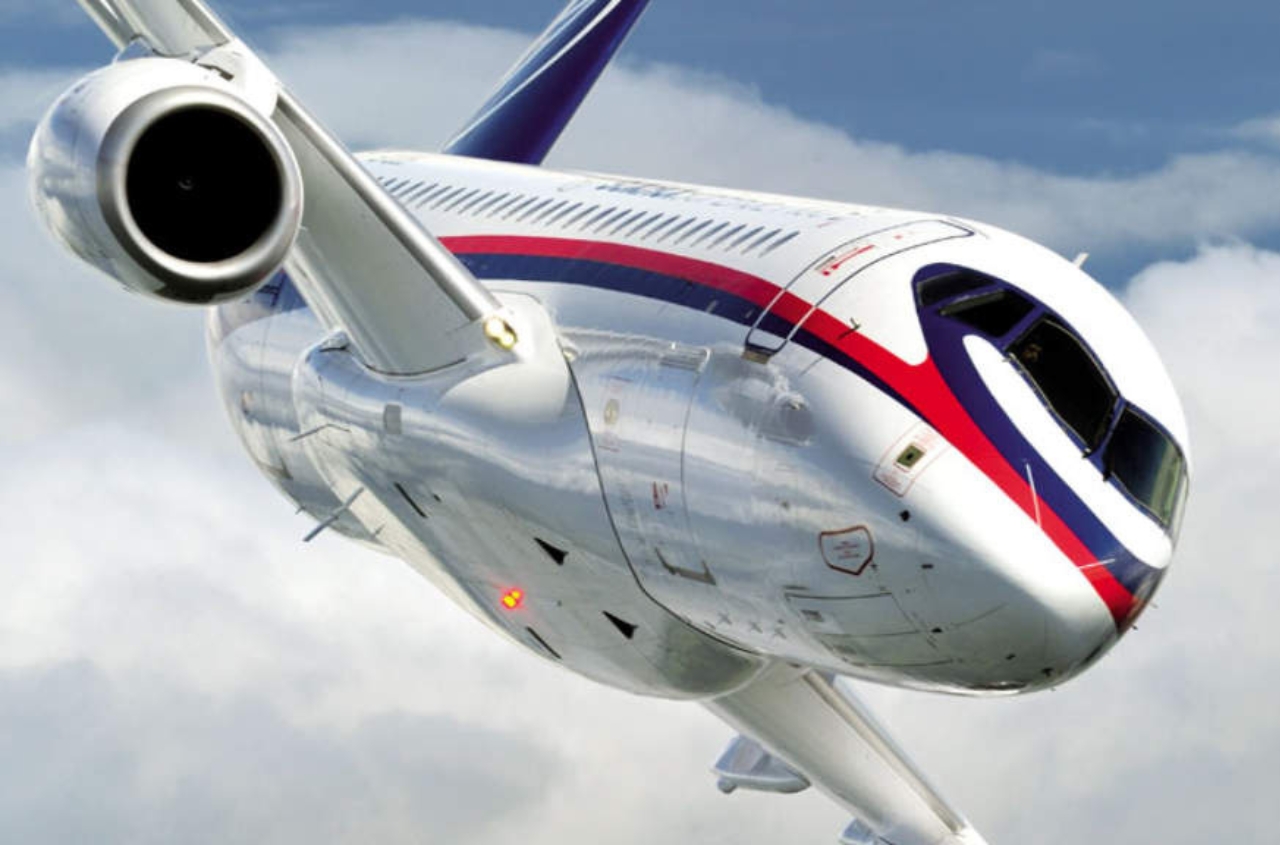

The Russian Ministry of Industry and Trade has announced a tender to extend the service life of Sukhoi Superjet 100 aircraft. The contract is valued at $60.6 million, with a deadline of December 2028. The tender is seen as an acknowledgment that the populist programme to revive Russia’s aviation industry is falling apart.
The Comprehensive Programme for the Development of the Russian Aviation Industry through 2030, approved in June 2022, envisaged delivering 42 modernized SSJ100 aircraft to airlines. Only 12 have been delivered. The reason is straightforward: the PD-8 engine, without which serial production of the upgraded version is impossible, still does not have certification. The programme is stalled. The aircraft remain on the drawing board.
The same applies to other aircraft Russia was supposed to use to replace its foreign fleet: the MS-21, Il-114-300, Tu-214, and Il-96-300. Out of the entire list, only one additional aircraft has entered service with airlines — a Tu-214. Plans to produce 120 and later 200 aircraft per year have effectively turned into a statistical joke.
Now the ministry is offering a different solution instead of new aircraft: keep the old ones flying longer. Research and development work is expected to increase the SSJ100’s flight cycle limit from the current 10,000–15,000 to 15,000–20,000 cycles, flight hours from 15,000–25,000 to 25,000–40,000 hours, and the service life of certain modifications from 15 to 20 years. Since the contract value is relatively small for the aviation sector, this effectively amounts to a paper-based extension of service life with minimal technical substance.
There are currently about 159 SSJ100 aircraft in operation, nearly half of them with the Rossiya airline from the Aeroflot group. Some of these aircraft depend on SaM146 engines produced by the joint venture PowerJet with France’s Safran — a company that left Russia after February 2022. How this France-dependent equipment will be maintained after the service life extension remains an open question, with no answer provided in the tender documentation.
In addition, Russia’s UEC-Saturn, which holds 50% rights to the SaM146 engine through the PowerJet joint venture, refuses to take responsibility or recognize itself as the engine’s developer. Because of this, it is impossible to carry out major overhauls in Russia or approve changes to the aircraft documentation. At present, UEC is recognized only as a developer of modifications that can update service bulletins and distribute them to operators. It categorically refuses to assume responsibility for life extension and major engine repairs.
The failure of the programme is also reflected in revised targets. Moscow had previously expected that by 2030, domestic aircraft would make up 80% of Russian airlines’ fleets. The target has now been lowered to 50%. The reality is even more modest: as of May 2026, the share of domestic aircraft in the fleet is about 19%, with a forecast of 20% by the end of the year.
Extending the SSJ100’s service life is not a technical solution, but a way to conceal a collapse. Russia cannot build new aircraft in sufficient numbers, so it is paying to keep old ones flying longer. The longer these aircraft remain in the sky, the higher the risk for passengers — and the more visible the collapse of what the Kremlin once called its “technological sovereignty” programme.