


By Max Gardus
Can Putin force Ukraine to stop strikes on Ust-Luga due to the risk of a gasoline crisis in Berlin?
Ukrainian drones have forced Russia’s oil logistics to operate under constant stress. Now the Kremlin is trying to respond not only with air defense or repairs, but with a political trap: linking Ukrainian strikes on Russian ports to the risk of a gasoline crisis in Berlin.
At first glance, it sounds like an overly complex chain: Ukrainian drones hit Russian oil infrastructure, Russia stops or reroutes Kazakh oil, the refinery in Schwedt in northeastern Germany loses part of its supply, Berlin and Brandenburg begin to feel pressure, and pro-Russian forces in Germany gain a new argument against sanctions and support for Ukraine.
But this is exactly what the new dimension of energy warfare looks like today.
It is not only about oil. It is about the Kremlin’s attempt to turn its own vulnerability — strikes on Ust-Luga, Novorossiysk, the “Druzhba” pipeline, and other infrastructure — into a political lever against Ukraine.
The key node in this story is the PCK Schwedt refinery in the state of Brandenburg, about 100 km northeast of Berlin. It is one of Germany’s most important oil refineries, with a capacity of around 11.5–12 million tons of oil per year. It supplies most of the fuel for Berlin, Brandenburg, and parts of eastern Germany. In German and Western assessments, a frequently cited figure is that up to 90% of fuel for Berlin and Brandenburg is linked to Schwedt.
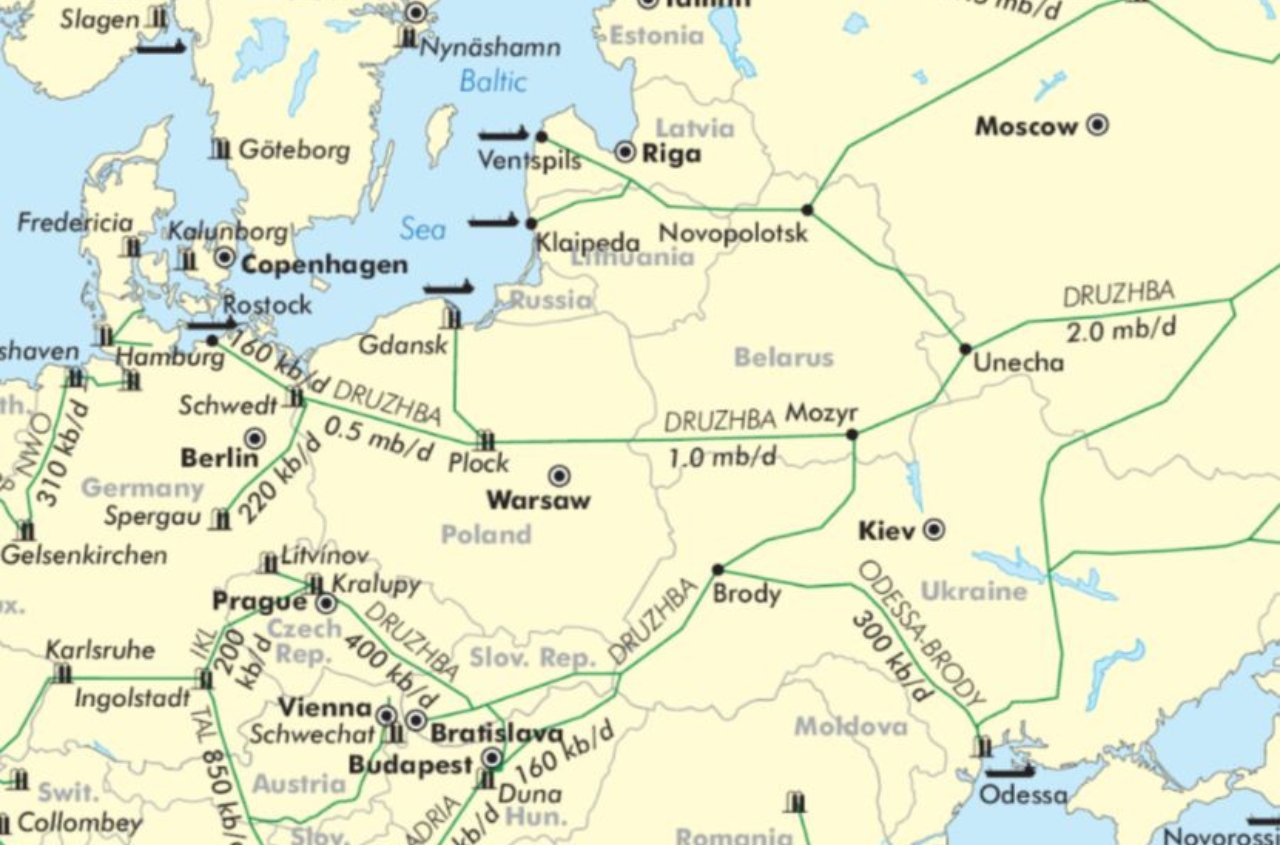
Before the full-scale war, the refinery was historically “designed” for Russian oil delivered via the Druzhba pipeline. After 2022, Berlin formally abandoned Russian oil, but part of the new setup remained tied to Russian infrastructure: Kazakh oil began arriving at Schwedt via the same Druzhba pipeline through Russian territory. So on paper it is no longer Russian crude, but in physical reality the route still passes through Russia.
And this is exactly where the Kremlin applied pressure on a sensitive point.
As of May 1, 2026, Russia announced the suspension of transit of Kazakh oil to Germany via the “Druzhba” pipeline. Russian Deputy Prime Minister Alexander Novak explained this with a vague reference to “technical capabilities.”
But the numbers show why this matters: in 2025, Kazakhstan supplied Germany via Druzhba with 2.146 million tons of oil, or roughly 43,000 barrels per day. In the first quarter of 2026 alone, another 730,000 tons were delivered. For Schwedt, this accounts for about 17% of its annual crude supply base.
Formally, this is not a collapse. But for a refinery that is already operating below full capacity, it is a serious blow. In May, Brandenburg authorities stated that supplies for the PCK refinery are secured at about 80% of capacity. Previously, the figure was around 85%. This means Schwedt is still operating, but its safety margin is shrinking.
Brandenburg’s Prime Minister Dietmar Woidke is trying to avoid panic. His approach is to stabilize the refinery, preserve jobs, and prevent the issue from becoming a social flashpoint in eastern Germany. After a meeting of the crisis task force, he stated that PCK’s utilization “remains stable,” that May supplies are secured at 80%, and that jobs are protected. This is important not only economically but also politically: more than 1,000 people work at Schwedt, and the entire local industrial cluster depends on the refinery. That is why the federal government has extended employment guarantees for PCK workers until the end of 2026.
The official plan of Berlin and Brandenburg consists of three parts: Gdańsk, Rostock, and legal separation from Rosneft.
The first direction is the Polish port of Gdańsk.
The idea is simple: tankers deliver oil by sea to Poland, and it can then be transported via pipeline systems to Germany. The Polish operator PERN has confirmed the technical possibility of supporting alternative supplies. However, Warsaw does not provide unconditional guarantees: additional volumes depend on operational, logistical, and market factors. In other words, “we can help” does not mean “we can fully replace a stable pipeline.”
The second direction is Rostock–Schwedt. This is Germany’s Baltic Sea route: tankers arrive at the port of Rostock, and the crude then flows through a pipeline to Schwedt. The problem is that this pipeline was historically not designed to fully replace Druzhba. Therefore, PCK had earlier requested around €400 million in state support to modernize the Rostock–Schwedt pipeline.
This project is intended to increase capacity and make the refinery less dependent on Russian routes, but it is not a quick solution.
The third direction is the most sensitive: Rosneft. The Russian company still legally owns 54.17% of the PCK Schwedt refinery, although since 2022 the plant has been under de facto control of the German state through a trusteeship mechanism. Rosneft continues to sue the German government: a new lawsuit was filed in March 2026, and Reuters reported it on May 6. This creates a “frozen” ownership status, blocks investment, and complicates the sale of shares held by other shareholders, including Shell.
This is why the situation is dangerous: technically, alternatives exist, but they are more expensive, more complex, and politically vulnerable. A pipeline provides a stable flow. Maritime logistics via Gdańsk or Rostock means freight costs, insurance, port transshipment, competition for tankers, different oil grades, and the need to adapt the refinery. And Schwedt was historically configured for a specific type of crude.
This is where the Kremlin can build its calculation.
The chain looks like this: Ukraine strikes Russian oil infrastructure → Russia announces “technical” issues with Kazakh oil transit → Schwedt loses 17% of its crude supply → Berlin and Brandenburg become concerned about fuel supply, jobs, and prices → AfD and BSW enter the debate → the federal government faces internal pressure → Moscow expects Germany to indirectly push Ukraine to be “more careful” with strikes on oil logistics.
Official Berlin does not do this. German Economy Minister Katherina Reiche speaks about supply security, stabilizing Schwedt, and alternative routes, not about pressuring Kyiv. Woidke also does not call for a return to Russian oil. His plan is to keep PCK running, preserve jobs, and secure infrastructure solutions for the region.
But another, more pro-Russian part of German politics is already moving in the opposite direction.
AfD promotes the old argument: sanctions hurt Germany more than Russia, and the energy break with Moscow was a mistake. For them, Schwedt is an ideal case: eastern Germany, industrial jobs, fear of fuel prices, distrust of Berlin, and war fatigue. Their message is simple: “look, supporting Ukraine and sanctions are creating problems for ordinary Germans.”
BSW, led by Sahra Wagenknecht, acts more subtly but in essentially the same direction. Its political line is “pragmatism,” “peace,” “cheap energy,” criticism of sanctions, and calls to revise policy toward Russia. In Brandenburg, BSW already uses the Schwedt issue to pressure the government and in some cases acts in parallel with AfD. For the Kremlin, this is convenient: even if the federal government does not echo Russian narratives, internal German opponents can amplify them.
In this scheme, Kazakhstan becomes the third hostage.
On the one hand, Astana sells not Russian oil, but its own crude.
On the other hand, the main export routes still pass through Russian territory or Russian infrastructure: Druzhba, CPC, Novorossiysk, and partially Ust-Luga.
Kazakhstan needs Germany and the EU as markets, but it cannot fully and quickly break free from dependence on Russian transit. This is why Moscow can use Kazakh oil as a “harmless” instrument of pressure: formally it is not reducing its own exports, but merely citing technical transit issues.
The key question now is: can the Kremlin really force Ukraine to stop strikes on Ust-Luga due to the risk of a gasoline crisis in Berlin?
Directly — almost certainly not. Ukraine strikes Russian oil infrastructure not as a political signal, but because it is part of Russia’s war economy. Oil finances the war, supports the state budget, logistics, foreign currency inflows, and the Kremlin’s ability to continue its aggression. Ust-Luga, Novorossiysk, Primorsk, oil depots, refineries, and pipeline hubs are not a “civil abstraction,” but elements of the energy machinery of war.
But the Kremlin can do something else: increase the diplomatic cost of such strikes. Not forbid Ukraine from striking, but create political noise around each attack: “this harms not Russia, but Berlin,” “this affects Kazakhstan,” “this creates risks for the European market,” “this will raise fuel prices for Germans.”
This is precisely the trap.
If Schwedt is maintained at 80%, Gdańsk and Rostock cover the deficit, and Berlin avoids a price shock, the Russian strategy does not work. Then everything is reduced to yet another argument for Germany to accelerate the construction of a post-Russian energy infrastructure.
If, however, supply becomes unstable, the refinery drops below comfortable utilization levels, fuel prices in Berlin and Brandenburg rise, and AfD and BSW amplify the narrative that “sanctions against Russia are destroying our industry,” then the Kremlin gains a political card — not a military one, but an informational and diplomatic one.
Therefore, the correct answer is: the Kremlin is unlikely to be able to force Ukraine to stop strikes on Ust-Luga. But it is clearly trying to make strikes on Russian oil logistics a problem not only for Moscow, but also for Berlin.
And here the key question is no longer for Ukraine. The question is for Germany: why, four years after the start of Russia’s full-scale war, does Russia still have leverage over fuel supplies to Berlin?
If the German answer becomes “pressure Ukraine,” that would mean the Kremlin has achieved its goal. But at present, such a scenario looks unlikely.
If the answer is “finish building Gdańsk, Rostock, modernize Schwedt, and fully remove Rosneft,” then the Russian energy trap will fail.
And Europe’s dependence on Russian fossil fuels will decrease even further — which is a strategic gain for Ukraine.