

Germany is Ukraine’s largest partner in terms of security assistance: its support accounts for about one-third of all aid provided to Ukraine. At the same time, cooperation between Ukraine and Germany goes beyond the classic model of donor support.
This is a win-win partnership in which Germany strengthens key capabilities of the Ukrainian Armed Forces — air defense, Ukrainian drones and missiles, long-range artillery ammunition — while Ukraine provides access to unique combat experience, technologies, and data from modern warfare.
This cooperation simultaneously strengthens Ukrainian forces today and shapes Europe’s future defense architecture, where Ukraine and Germany act as leaders in the security field.
Support for key priorities
Germany supports precisely those areas that currently determine Ukraine’s ability to implement its strategy: defending the skies, containing the Russian offensive on the front line, and striking the economic capacity of the aggressor.
In 2026, Germany plans to allocate at least €11.5 billion for military assistance to Ukraine. These resources will finance both already signed contracts and the current needs of the Defense Forces.
Air defense: protection of cities, energy, and critical infrastructure
Air defense remains one of the main pillars of German support.
During the April Ramstein meeting, Germany announced a large package to strengthen Ukraine’s air defense and strike capabilities. This includes $4 billion specifically for air defense reinforcement and $600 million for the development of deep-strike and medium-strike capabilities.
Also significant was the initiative of German Defense Minister Boris Pistorius to urgently strengthen Ukraine’s air defense. Within this initiative, €2 billion from partners was mobilized. This decision helped Ukraine receive critically needed missiles to protect its skies during the most difficult period.
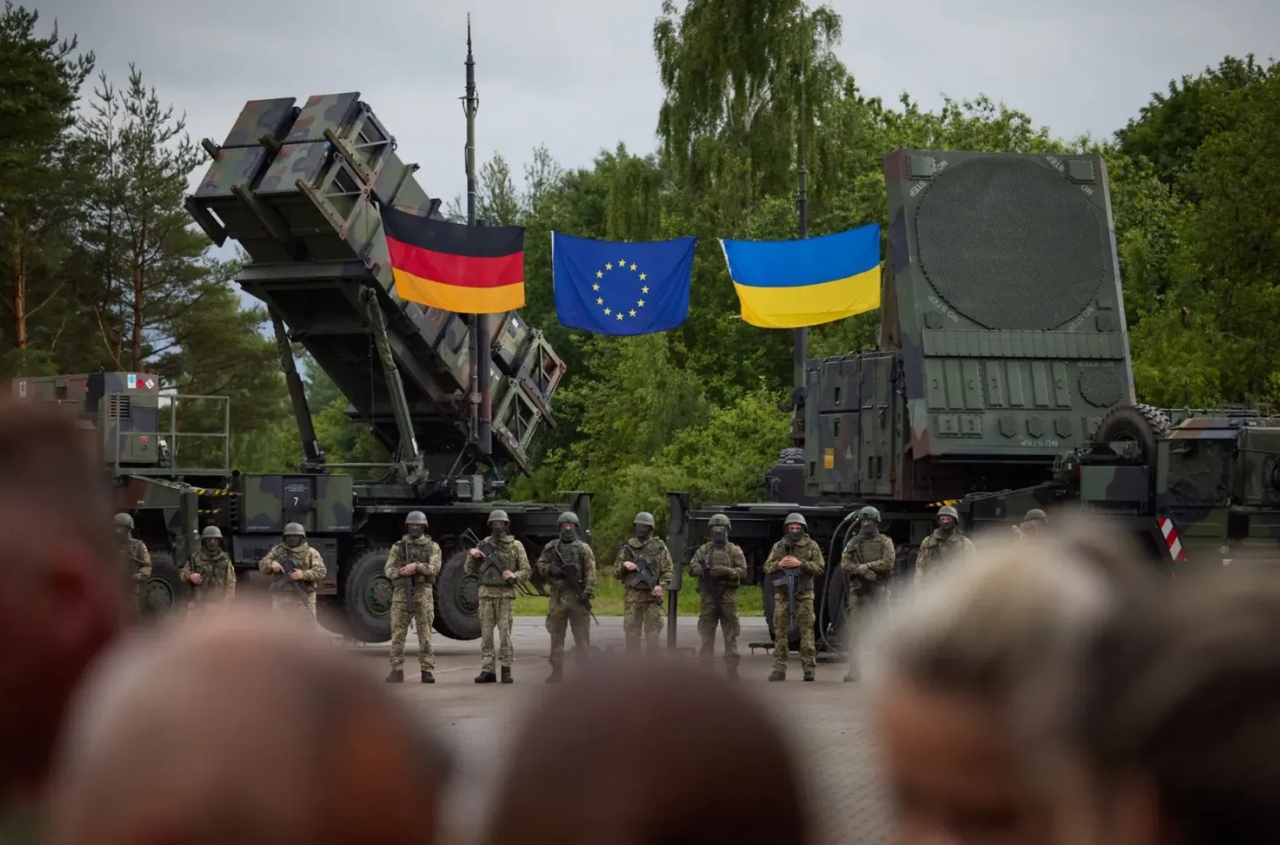
A separate strategic project is a contract with Raytheon for the supply of several hundred missiles for Patriot systems. The contract is worth €3.2 billion, and its financing is provided by Germany.
In addition, the supply of launchers for IRIS-T air defense systems is planned. The agreement is estimated at nearly €200 million and is also financed by the German side.
Germany is also one of the key participants in the Prioritized Ukraine Requirements List (PURL) mechanism, which enables the rapid procurement of critically important American weapons for Ukraine. Overall, German support under PURL is already approaching $1 billion. This is a direct contribution to the protection of Ukrainian airspace, including the provision of missiles for Patriot systems.
Drones and missiles: scaling Ukrainian solutions
The second key direction is the scaling of Ukrainian drones and missiles.
Germany is investing in capabilities that have already proven effective on the battlefield. In particular, this includes “middle-strike” systems — means that allow targeting enemy logistics, warehouses, command posts, air defense systems, and other critical targets at a depth of more than 20 km from the front line.
Separate agreements have been concluded to finance Ukraine’s “deep-strike” capabilities with a range of up to 1,500 km. This includes €300 million in investment into the production of long-range weapons manufactured in Ukraine.
Ukraine and Germany are also developing joint production of unmanned systems. The sides have agreed to launch the production of middle-strike drones using innovative technologies, including elements of artificial intelligence.
The project foresees the creation of a joint enterprise on German territory, financing from Germany, and the delivery of all produced systems to the Ukrainian Defense Forces. In the first phase, this involves several thousand middle-strike drones.
Ongoing production projects involving German and Ukrainian companies are also being implemented. As part of cooperation between Germany’s Quantum Systems and the Ukrainian company Frontline Robotics, a service center has been established and UAV production has been localized. In 2026, deliveries of 10,000 Linza UAVs are expected.
This is an example of a shift from traditional aid to joint production, where Ukraine scales up combat technologies while Germany gains access to solutions tested in real warfare.
Long-range munitions: supporting artillery on the front
The third priority is long-range artillery ammunition.
Germany is one of the key participants in the Czech ammunition initiative. The federal government has financed ammunition supplies for Ukraine worth nearly €900 million.
For Ukraine, extended-range munitions are particularly important. They allow Ukrainian artillery to operate more effectively and strike the enemy at greater distances.
Brave Germany: joint innovation for the war of the future
Another area of cooperation is defense innovation.
Ukraine and Germany are launching “Brave Germany.” This is a joint program for developing defense technologies and supporting innovative startups.
The program provides grant support for Ukrainian and German startups working on critical defense tech areas, including:
- drone technologies
- artificial intelligence
- new communications solutions
- missile technologies
- other areas of modern warfare
“Brave Germany” is part of a new model of cooperation in which Ukraine not only receives support but also provides partners with access to combat experience, technologies, and data that other countries do not possess.
Data exchange: a new level of partnership
Ukraine and Germany have also signed Ukraine’s first agreement on the exchange of defense data with partners. This opens a new level of interaction in the field of defense technologies and analytics.
The memorandum provides for the launch of joint data-sharing projects. In particular, it includes analysis of the use of German weapons systems such as the PzH 2000, RCH 155, and IRIS-T, as well as the exchange of Ukrainian developments and battlefield data.
German partners will gain access to unique data from DELTA and other digital systems. This will allow them to develop technologies, improve their own capabilities, and prepare armed forces for modern warfare.
Support for the training of Ukrainian soldiers
Germany is also allocating over €10 million to a European Union initiative to create military training centers in Ukraine. This will contribute to more effective, safer, and more comfortable training for soldiers.
From assistance to a shared European force
Ukraine and Germany are gradually transitioning from a model of aid to a model of strategic partnership.
Germany finances critical needs of the Defense Forces, supports Ukrainian production, develops joint projects, and invests in innovation. Ukraine, in turn, provides partners with access to technologies, combat data, and experience from modern warfare.
This is a win-win cooperation that strengthens Ukraine today and shapes the future architecture of European security.
Ukraine is sincerely grateful to Germany, the federal government, Defense Minister Boris Pistorius, and the German people for their leadership and consistent support.