



Since February 24, new import tariffs have come into effect in the United States, and Ukraine has emerged as one of the countries most affected, according to a report by the European Bank for Reconstruction and Development (EBRD).
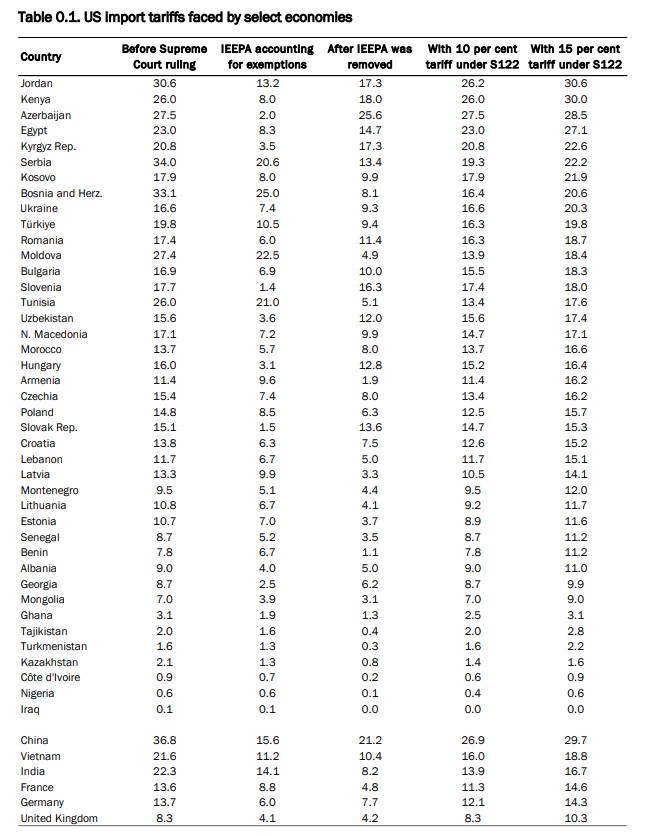
After the U.S. Supreme Court canceled previous tariffs under the IEEPA law on February 20, the White House administration introduced new tariffs of 10% within hours and, on February 22, raised them to 15% under Section 122 of the U.S. Trade Act of 1974.
“Although the overall tariff change was relatively modest, the new regime created clear winners and losers,” the EBRD report notes.
Ukraine falls into the second category: it is among the five countries in the EBRD region experiencing the largest increase in tariff burden. Alongside Ukraine are Armenia, Egypt, Kenya, and Kosovo. Before the court ruling, Ukraine’s average tariff was 16.6%; after the new tariffs, it rose to 20.3%.
"The US import tariff faced by the EBRD regions, on average, increased by 0.3 percentage points with 29 economies in the EBRD regions now being subject to higher tariffs. Armenia, Egypt, Kenya, Kosovo and Ukraine saw the largest increases while the biggest winners were Bosnia and Herzegovina, Serbia, Moldova and Tunisia,” the EBRD report notes.
Ukraine’s exports to the U.S. in 2024 amounted to $874 million, with the largest shares in pig iron ($363 million) and pipes ($112 million). Meanwhile, imports from the U.S. to Ukraine totaled $3.4 billion, significantly higher than exports.
Ukraine exports more than 600 categories of goods to the U.S., of which 65 categories exceed $1 million in export value.
At the same time, some countries in the region benefited from the new regime. Tariff burdens fell by 12 percentage points for Bosnia and Herzegovina and Serbia, 9 points for Moldova, and 8 points for Tunisia. This is because these countries previously had much higher individual IEEPA tariffs, now replaced by a single flat rate.
Overall, in the EBRD region, the U.S. average import tariff rose from 14.6% to 15%, with 29 countries now facing higher rates. The new U.S. tariff regime was introduced after the Supreme Court canceled tariffs under the International Emergency Economic Powers Act (IEEPA) on February 20, 2026. In response, former President Trump announced replacing the canceled tariffs with a single additional tariff under Section 122 of the Trade Act of 1974, initially set at 10% and raised the next day to 15%.
The regime took effect on February 24, 2026, and will remain in place for 150 days—until July 24, 2026—unless extended by Congress. At the 15% rate, the U.S. weighted average tariff will be 13.2%. For comparison, it was 15.3% before the court decision and dropped to 8.3% after the IEEPA tariffs were canceled.