



A recent analysis by Lucas Šimonis, an expert in international law, defense, and global security, examines the emerging Baltic defense line as a strategic attempt to balance mobility, protection, and deterrence. He shared his point ov view with Militarny
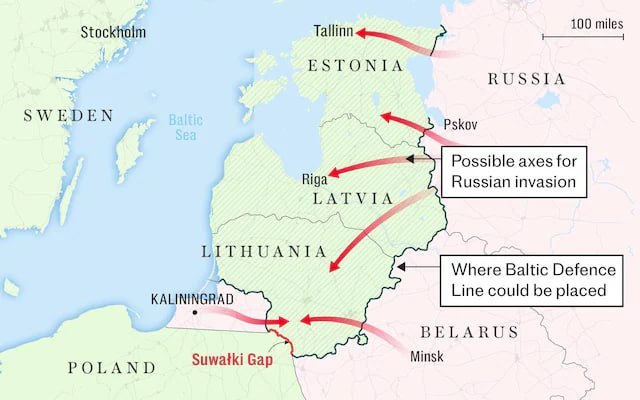
The project spans over 700 kilometers along the borders with Russia and Belarus and is expected to reach its basic configuration by 2027, with gradual reinforcement thereafter. Rather than aiming to halt an adversary at the border, the line is designed to slow an advance, buying crucial time for NATO’s main forces to mobilize.
The defense strategy relies on echeloned positions, including anti-tank ditches, “dragon’s teeth,” minefields, and pre-designated infrastructure demolition zones targeting bridges and roads. Unlike static fortifications of the 20th century, the Baltic line functions as an early-warning and engagement system, compelling any advancing force to enter prepared kill zones.
A distinctive feature is the so-called “counter-mobility parks” — pre-positioned engineering stockpiles that can be rapidly deployed wherever needed. These dispersed and mobile elements increase resilience against precision strikes and drone reconnaissance, addressing vulnerabilities inherent to conventional linear defenses.
The defensive network is complemented by mobile firepower, primarily M142 HIMARS rocket systems, capable of striking targets up to 300 kilometers deep. Coupled with NATO’s intelligence and reconnaissance assets, these systems allow for hit-and-run operations, maintaining constant pressure on advancing forces while staying largely out of reach of enemy countermeasures.
Geography plays a critical role in shaping the concept. The flat terrain of the Baltic states leaves few natural barriers, making static defense impractical. Slowing and disorganizing an opponent, rather than holding a line, becomes the central objective, particularly given the limited manpower and resources of Estonia, Latvia, and Lithuania.
However, the plan faces notable risks. Coordination gaps between the three states could create weak points, while both over- and under-saturation of fortifications carry their own dangers: excessive defenses may lead to high casualties, whereas insufficient obstacles could allow rapid enemy breakthroughs — a lesson reflected in historical examples such as the Bar-Lev Line.
Another challenge lies in integrating the line with NATO offensive operations. Mines, destroyed roads, and anti-tank obstacles slow not only the enemy but friendly counterattacks, demanding careful engineering planning and command coordination. In addition, fortifications may be captured and used by an adversary if positions are lost.
Air threats remain significant. Even hardened bunkers are vulnerable to precision-guided bombs beyond the coverage of most Baltic air defenses. Without comprehensive aerial protection, these installations could become priority targets during the opening hours of any conflict.
Ultimately, Šimonis concludes, the Baltic defense line is not a traditional “shield” but a tool to buy time. Its effectiveness depends on coordination among Baltic forces, construction pace, and the ability to adapt doctrine to modern warfare realities. In many ways, it resembles the logic of Finland’s Mannerheim Line more than France’s Maginot Line — a flexible, layered defense designed to delay and disrupt rather than completely stop an adversary.