

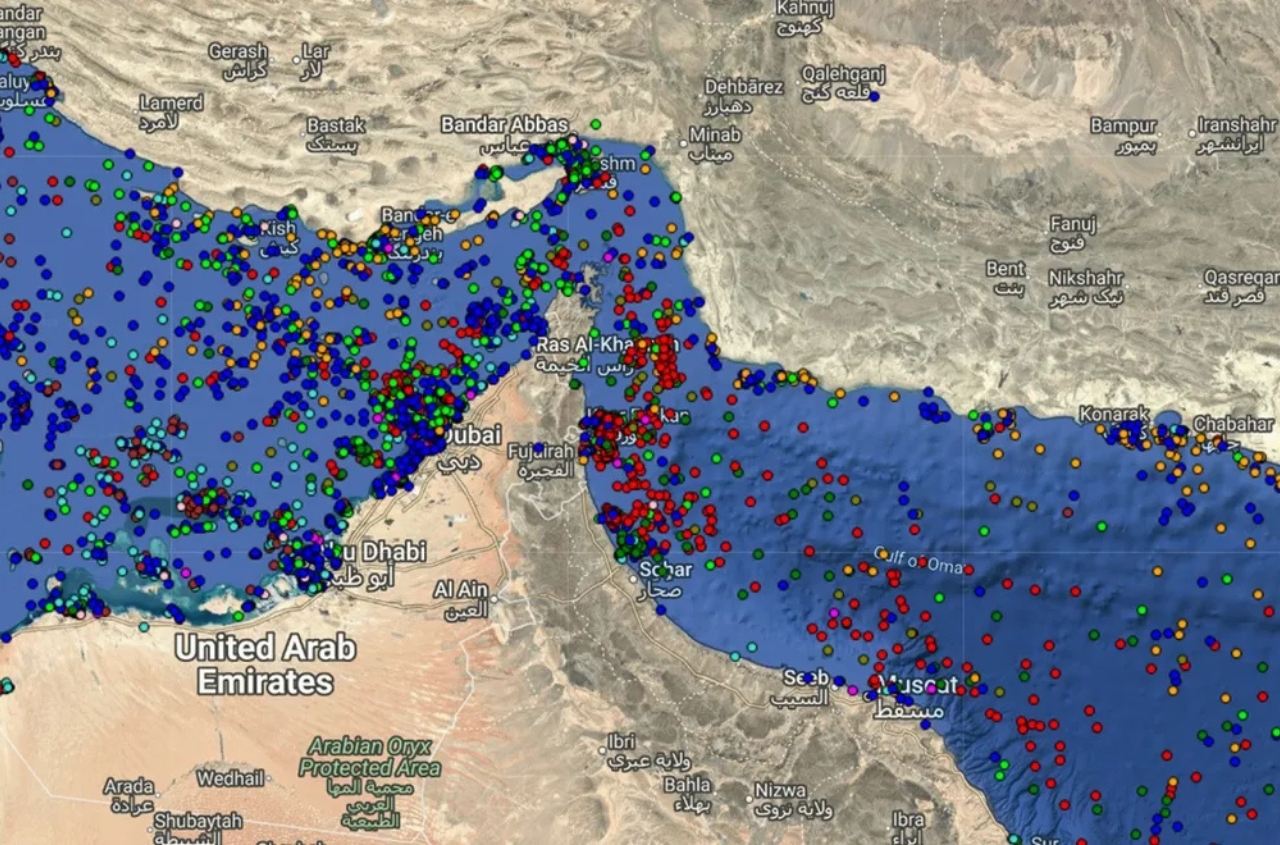

Existential war in the Persian Gulf. This is not just about stopping oil traffic through the Strait of Hormuz.
It’s also about blockading food supplies to the Gulf countries (all of which are deeply dependent on imports of grain and other agricultural goods).
It’s also about the risk of strikes on desalination plants in Gulf countries and water shortages during the summer heat.
It’s also about attacks on energy infrastructure.
The local infrastructure was not built by the USSR, so it is technologically advanced, modern, beautiful, and… extremely fragile in wartime.
Saudi Arabia has 35 million residents, with an extremely high level of urbanization—91% of the population lives in cities.
There are no rural provinces or villages where part of the urban population could relocate to relatives during a crisis.
The local ecosystem in the form of oases was not designed for such a population. The ecosystem has been “cheated” with desalination plants and air conditioning.
Luxury real estate in Dubai in the summer, in a skyscraper at over +50°C without water and electricity (i.e., without air conditioning), becomes a deadly trap.
Without desalination plants, water supply and sewage systems do not function. There are no large rivers to draw water from.
This is a very fragile geopolitical ecosystem, like a greenhouse’s delicate, demanding flower that requires meticulous and highly regulated care.
This ecosystem was created through artificial “pumping” fueled by enormous inflows of oil capital.
Waging war there is like throwing stones in a glass room.
Iran has already tested a tool of infrastructure paralysis: cutting off natural gas supplies to Iraq.
As a result, a gas power plant stopped, and the country experienced a complete blackout.
And Iraq earns up to $100 billion a year from oil exports, yet it has never been able to create a closed energy system.
War can destroy the geo-economic and geo-social ecosystem of the region—not over several years, but within a year.
Regarding oil:
Through the Strait of Hormuz, 20 million barrels per day pass—or roughly 20% of global oil traffic.
This is equivalent to the daily oil consumption of the United States or China, or double the daily oil consumption of the EU.
The global geopolitical gain will go to whoever unblocks the existential paralysis of the Gulf states first, primarily in countries like Saudi Arabia, Qatar, Kuwait, the UAE, and Bahrain.
And, for the first time, this may not only be done by the United States.
The very fact that we are discussing such a global alternative indicates tectonic shifts in the world’s cluster-fragmentation system.
The U.S. could deliver a strategic defeat to Iran (displacing the political regime there) if it mobilizes resources comparable to the Iraq War.
But responding to the existential challenge in the Gulf, for the first time in history, could also be done by China (as part of geopolitical mediation).
Whoever solves this challenge will gain the Middle East with all its “Aladdin’s Cave” treasures.
In other words, they would secure the largest prize in the context of world-system wars of the Nonpolar World era.
And there will be several such “trophies” at this stage.