

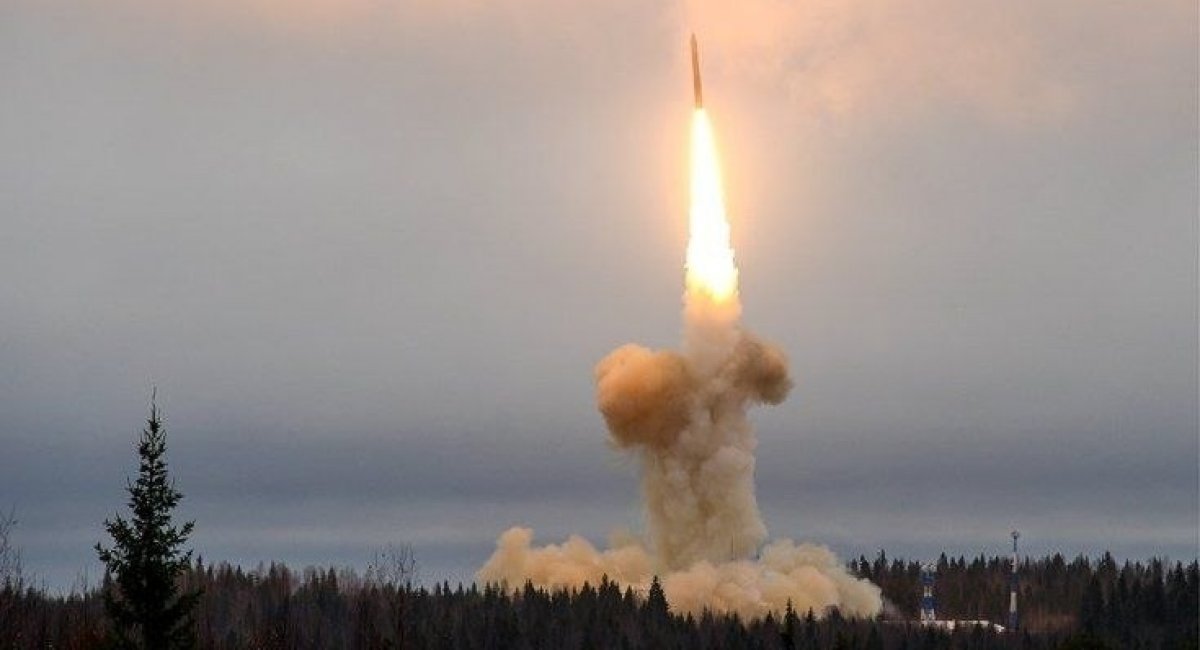

In the illustrative photo: the launch of a converted “Start” family launch vehicle.
Russia is in fact pursuing several projects in this direction, but the already widely discussed “Bureau-1440” turned out to be the most publicly known.
As one example of another initiative, even Gazprom operates its own five-satellite “Yamal” constellation, whose capabilities are also used to provide communications for Russian occupying forces.
The communication satellites and related infrastructure were already a non-core business for Gazprom, and amid current financial losses they have become a heavy “burden” for which a buyer had to be found.
That buyer turned out to be a somewhat obscure company called “Novy Start” (“New Start”), which plans to purchase from Gazprom, by the end of 2026, both the “Yamal” satellite constellation, the mission control center, and even Gazprom’s satellite manufacturing facility in the Moscow region. It is reasonable to assume that the purchase is aimed at expanding the “Yamal” satellite group.
Moreover, “Novy Start” has publicly stated plans to invest, together with Roscosmos, up to around $8 billion (in ruble equivalent) in various projects over the next 10 years.
However, there is a nuance: the company has announced plans to use a launch vehicle in a new version called “Start-1M,” which is supposed to be produced by converting RS-12M “Topol-M” intercontinental ballistic missiles. The first launch of such a rocket was initially planned for 2026 but has now, in typical Russian fashion, been postponed to 2027.
What exactly prevents Russians from using existing “converted” Start rockets in this project remains unclear.
In other words, Russia can talk as much as it wants about building a “Starlink alternative” based on satellite communications, but everything ultimately depends on its ability to design, manufacture, and launch rocket carriers for those satellites.
Kremlin propagandists even claimed on April 12 that Ukrainian long-range drones almost disrupted a launch at the “Vostochny” cosmodrome in the interests of the Russian Ministry of Defence. As they say, nothing is entirely clear, but it is certainly interesting, and over time, this direction may also become a realistic target for Ukrainian long-range UAV operations.
So the narrative of “Russia building a Starlink alternative” inevitably now includes discussions about Russia’s “military space” capabilities—even if at first glance this topic may seem narrow or not very media-friendly.