

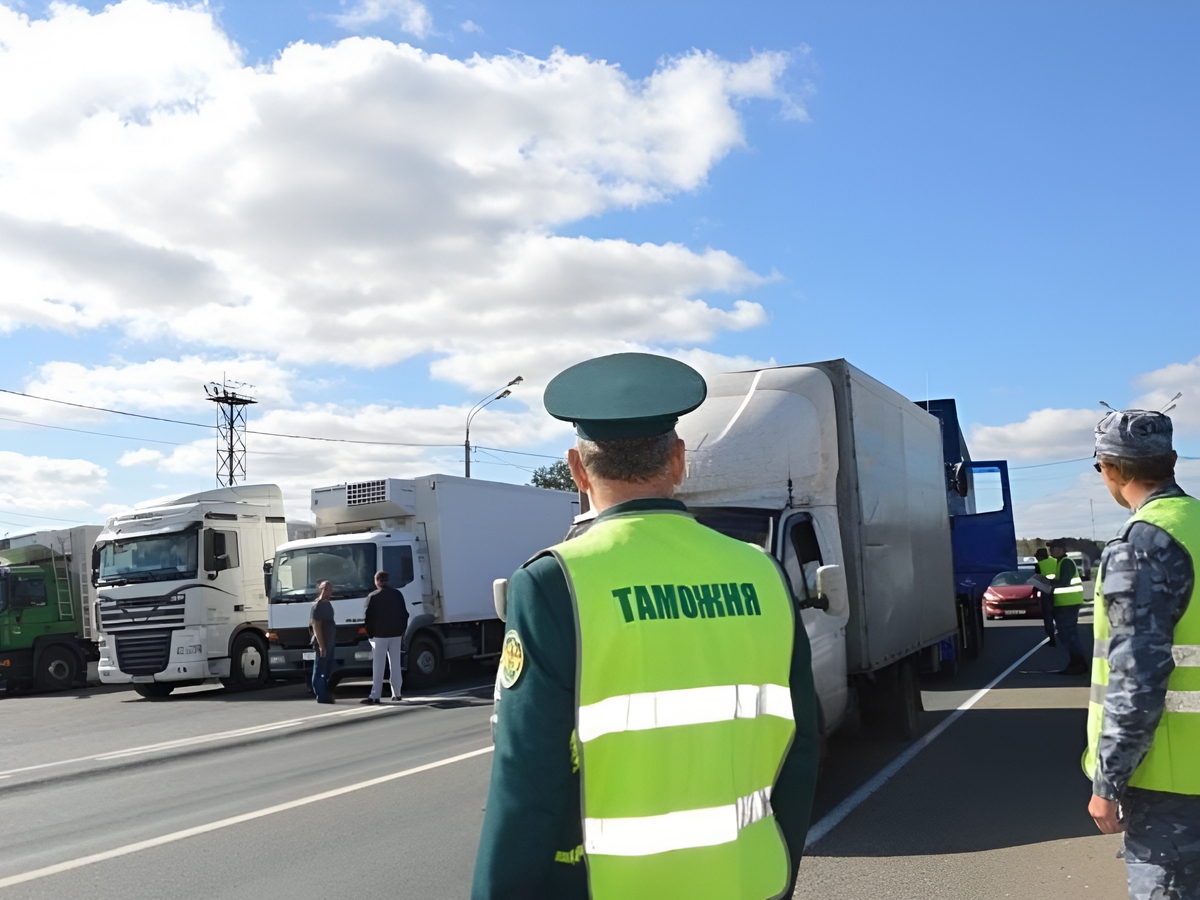

Main image: Russian customs officers look at incoming trucks. Central Asia serves as a pivotal back-door route for dual-use imports into Russia, according to CGCPS. (Photo: gov.kz)
Central Asian countries are acting as a key channel for Russian trade that violates international restrictions, providing logistical and financial support to networks redirecting goods for the needs of Russia’s military-industrial complex, according to Eurasianet.
The report Russia’s Sanction Evasion Research 2025-2026, published by the Washington-based Center for Global Civic and Political Strategies (CGPS), emphasizes that Russia has shown significant capacity to adapt and mitigate the impact of Western sanctions, with Central Asia becoming the main diversion route for imports.
According to the study, in 2025 there was a significant increase in flows from Kazakhstan, Kyrgyzstan, and Uzbekistan of goods on priority lists, including capacitors, transceivers, ball bearings, and automated machine tools.
Kazakhstan and Kyrgyzstan have open borders with Russia within the framework of the Eurasian Economic Union, which removes customs controls on trade inside the bloc. Electronics, microchips, and Western-made communication equipment classified as dual-use goods are imported into these countries as civilian products and then legally re-exported to Russia under local trade regulations.
Although regional governments deny involvement in sanction evasion, statistical data indicate a complex situation. In Kazakhstan, exports of priority goods to Russia increased by more than 400 percent in 2022, suggesting the existence of a systemic mechanism of circumvention based on shared infrastructure and minimal oversight. However, over the past two years, exports of such products from Kazakhstan have sharply declined, and a number of local companies have been placed under Western sanctions.
CGPS analysts conclude that the government of Kazakhstan is not involved in assisting Russia at a systemic level, but membership in the EAEU and a long shared border create vulnerabilities exploited by sanction-evasion networks.
Kyrgyzstan is criticized in the report not only for supplying goods to Russia but also for facilitating financing through access to international financial markets. The country is described as a significant node in sanction-evasion networks: in 2025, analysts identified several crypto platforms registered in the republic that served as transit points for Russia-linked financial flows. There are concerns that some exchanges may have operated as shell structures for platforms already under sanctions. In 2025, representatives of the United States, the European Union, and the United Kingdom found sufficient evidence of violations, resulting in sanctions against several Kyrgyz banks and the cryptocurrency exchange Grinex, and in April the EU imposed sanctions on the government of Kyrgyzstan as part of its 20th sanctions package.
The report also mentions the Caucasus, where Georgia is named as one of the most significant and high-risk nodes for transit and re-export, and Azerbaijan as an important logistics hub in the North–South corridor linking Russia with Iran and India.
The authors of the study recommend that the West allocate more resources to monitoring geographic chokepoints, including in Central Asia. CGPS calls for strengthened oversight and targeted sanctions against financial intermediaries, including insurance companies, legal service providers, and financial institutions. Focusing on such intermediaries, experts argue, could effectively deter networks involved in sanction evasion.