

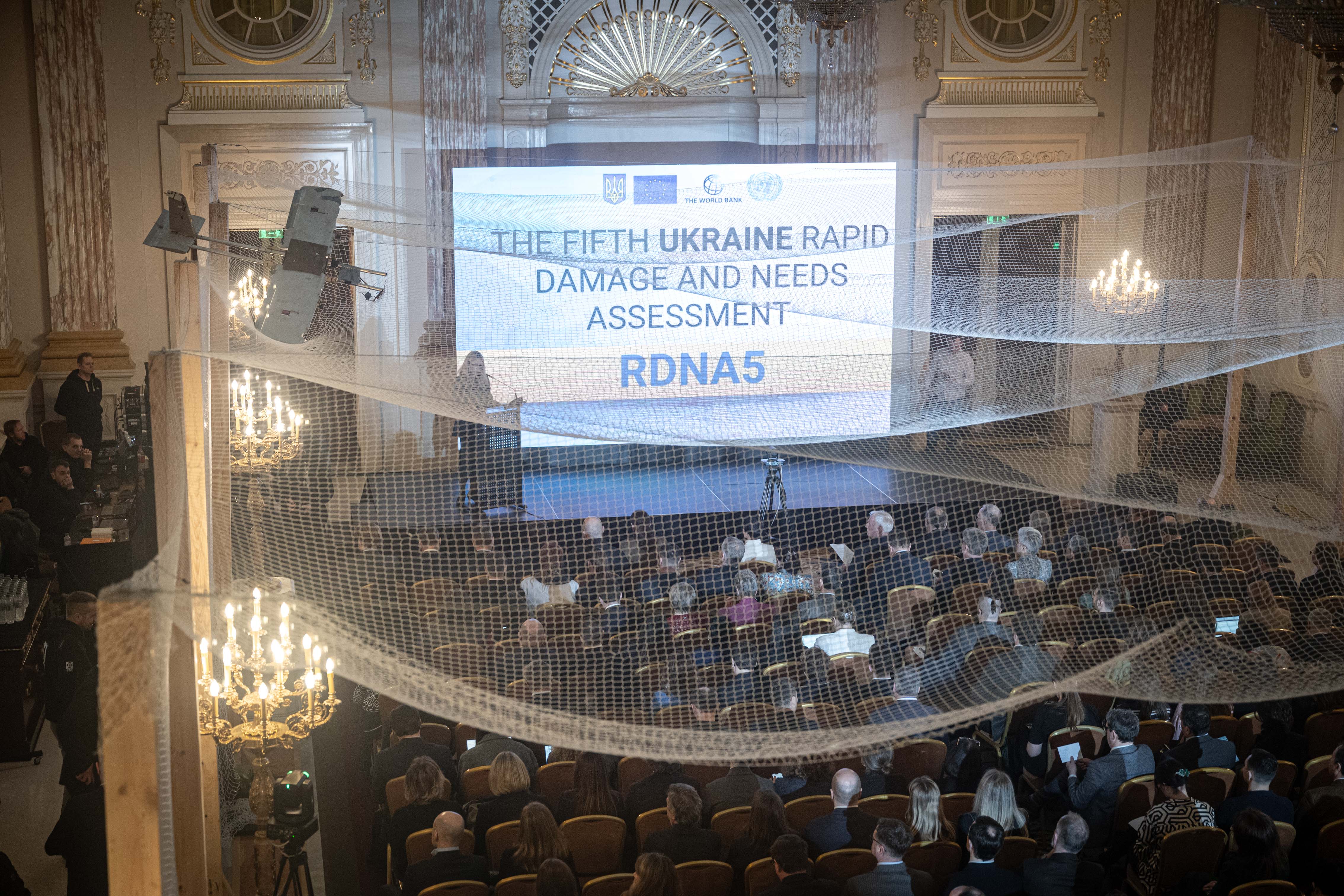
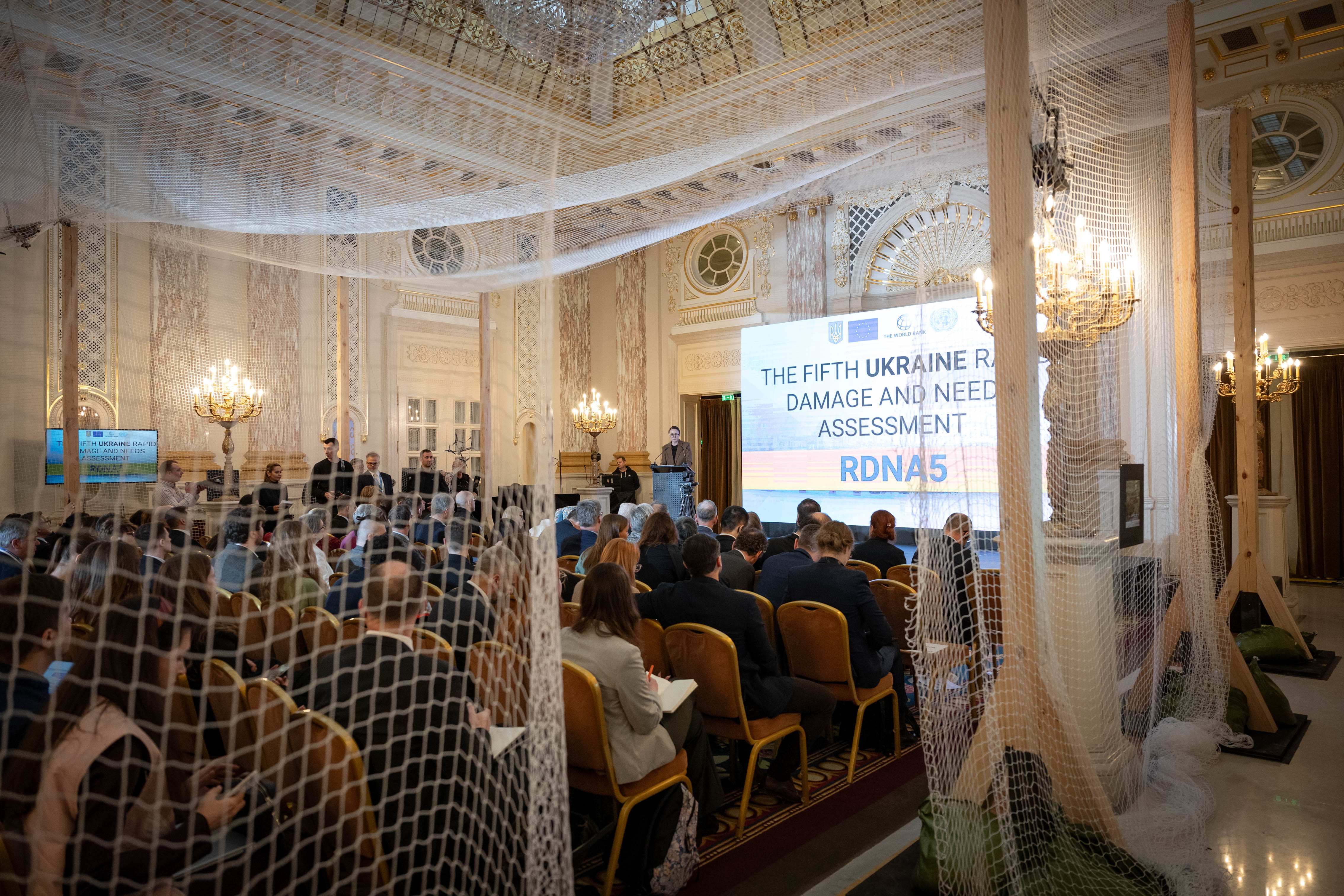
The Ministry for Communities and Territories Development of Ukraine, together with the World Bank, the European Commission, and the United Nations, presented the results of the fifth Rapid Damage and Needs Assessment (RDNA5), which evaluates the damage and needs arising from Russia’s full-scale invasion. RDNA5 covers the period from February 24, 2022, to December 31, 2025, and follows four previous RDNA reports.
According to RDNA5, total recovery and reconstruction needs over the next ten years amount to $588 billion. This is $64 billion more than a year ago.
The sectors most affected, according to the assessment, are housing (31% of total damage), transport (20.6%), energy (12%), as well as trade and industry (9%) and agriculture (6%).
The report was presented by Deputy Prime Minister for Restoration of Ukraine and Minister for Communities and Territories Development Oleksii Kuleba and World Bank Regional Director for Eastern Europe Bob Som. The Ministry’s team worked on the report for four months, coordinated by Deputy Minister Marina Denysiuk.
“The scale of Ukraine’s recovery has no parallel in modern history: our recovery needs for the next decade have already reached $588 billion. For the implementation of priority projects and programs in 2026, we currently have $5.8 billion in available financing, but the funding gap remains critical—$9.5 billion. The largest financing gaps are concentrated in the energy, housing, transport, and water supply and sanitation sectors. Recovery of one sector is impossible without the others. We are grateful to our partners who stand shoulder to shoulder with us, supporting Ukraine’s recovery by implementing European standards and the Build Back Better principle. Together, we are not just rebuilding the country—we are bringing Ukraine closer to EU membership,” said Oleksii Kuleba.

In 2025, Ukraine’s energy sector suffered significant losses, with even greater losses recorded in the first two months of 2026. As of December 31, 2025, total recovery needs for the energy system and district heating networks are estimated at $90.6 billion. The heating sector requires $1.6 billion in 2026 but is currently financed at less than 1%.
According to RDNA5, the largest overall recovery and reconstruction needs are in the transport sector—over $96 billion over the next decade. This figure reflects extensive destruction of roads, railways, bridges, and logistics infrastructure.
Since the beginning of the full-scale war, 14% of the housing stock—more than 3 million households—has been damaged or destroyed. More than 80% of the damage and destruction is concentrated in frontline and border regions. Approximately $90 billion will be needed for housing recovery over the next ten years, including $2.6 billion required in 2026.
All these sectors are interconnected and form the foundation for economic development. Overall, priority recovery areas include water supply, energy, housing, education, healthcare, civil protection, social support, transport networks, demining, and multi-sectoral projects.
The challenges related to Ukraine’s recovery and reconstruction needs were addressed in speeches by World Bank Managing Director Anna Bjerde, European Commissioner for Enlargement Marta Kos, and the UN Resident and Humanitarian Coordinator in Ukraine, Matthias Schmale.
The panel discussion “Financing Recovery Now: Priorities for 2026” was moderated by First Deputy Minister for Communities and Territories Development Alona Shkrum. Participants included Minister of Finance Serhii Marchenko, Minister of Economy, Environment and Agriculture Oleksii Sobolev, IFC Regional Vice President for Europe, Latin America and the Caribbean Alfonso Garcia Mora, and World Bank Vice President for Europe and Central Asia Antonella Bassani.
The fifth Rapid Damage and Needs Assessment (RDNA5) report is available via the provided link.