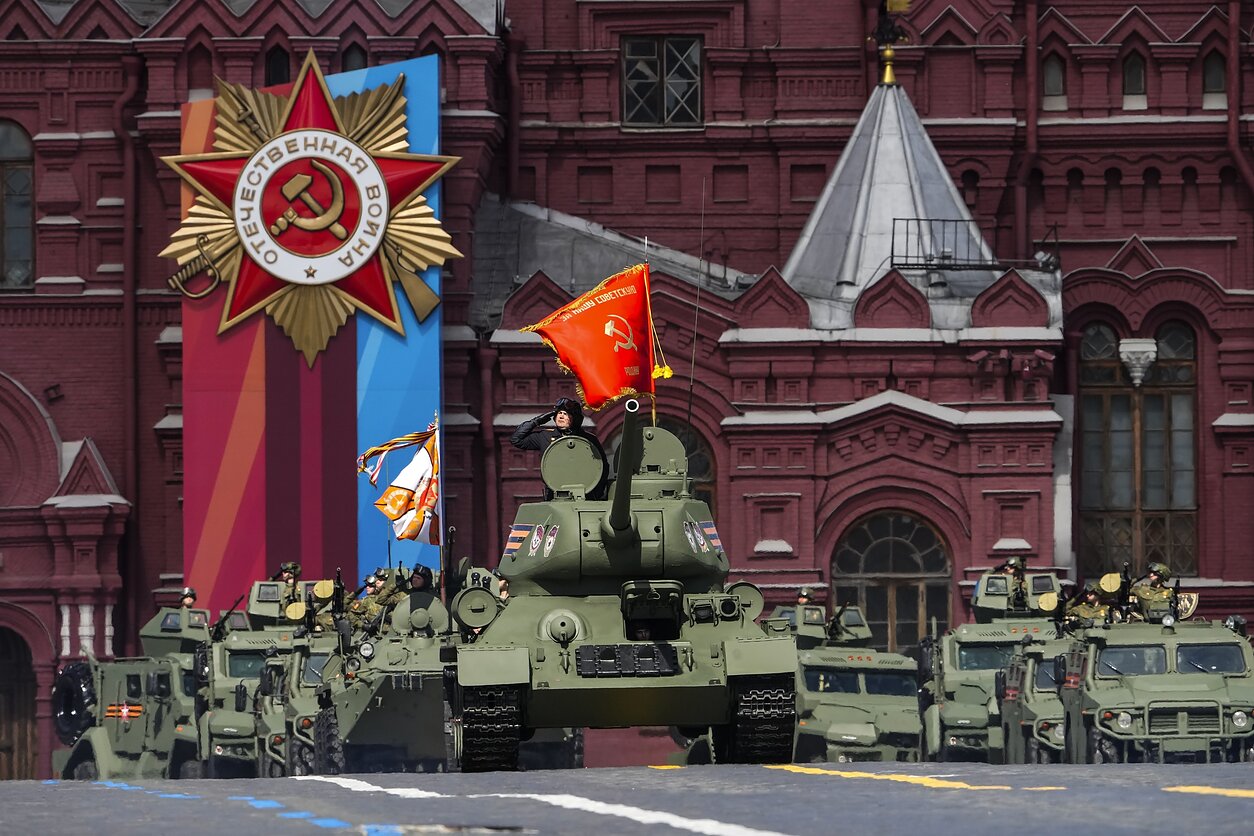

Main image: Military parade in Moscow (associative image) by AP
Lithuania’s national security is closely linked to the ongoing war in Ukraine, according to the country’s annual security assessment. The report, published by the State Security Department and the Second Investigation Department under the Ministry of National Defence, highlights that Russia’s focus on Ukraine limits its ability to launch a direct military threat against Lithuania and other NATO countries—at least for now, reports LTR.
“If Russia continues military operations in Ukraine at the same intensity as over the past four years, its war will demand significant human and financial resources, keeping its ability to threaten other states constrained,” the agencies said.
Still, the report warns that Moscow is steadily reforming its armed forces, creating new units, and expanding military infrastructure along NATO’s eastern border. Russian brigades are being upgraded into divisions, and new formations are being created, particularly in Kaliningrad, part of the Leningrad Military District. Many newly established units are not fully staffed and are deployed to Ukraine rather than remaining at their home bases. Russian forces in Kaliningrad are also using electronic warfare systems to disrupt satellite signals and falsify positioning data—a measure intended to protect military facilities but one that can interfere with nearby civilian aviation.
The assessment notes that Russia has been able to endure economic pressures, heavy troop losses, and international sanctions while gradually enhancing its military capacity. The country’s defence industry is continuing modernization and expanding domestic production of weapons, including hiring engineers to launch new production lines. Russia has often sought alternatives to Western technology, though advanced electronic components remain difficult to replace. Some high-tech systems rely on Chinese imports, which Moscow reportedly considers a strategic vulnerability. Analysts warn that within three to five years, Russia could become significantly more resilient to Western sanctions.
Lithuanian intelligence also examined the long-term implications if the war drags on for six to 10 years or if sanctions are lifted. In such scenarios, Moscow could fully staff its newly created units, potentially preparing for a limited conflict in the Baltic region within one to two years and a large-scale confrontation with NATO in six to 10 years.
“In the long term, Russia could build an army 30–50% larger than before the war and relatively modern,” the report says.
The report underscores that Russia’s strategic goals have not changed despite four years of conflict. Moscow continues to seek additional Ukrainian territory, aiming to bring Ukraine under its control and alter the balance of power in Europe. To achieve this, Russian intelligence and political campaigns have increasingly targeted European countries, portraying them as the main adversary rather than the United States, whose former administration showed more favorable positions toward President Vladimir Putin.
While Russia faces financial strain and has raised taxes, analysts argue that this is unlikely to curb its aggressive foreign policy. The country currently allocates about 38% of its budget—or roughly 7–8% of GDP—on defence and security, signaling Moscow’s determination to continue its war efforts and military modernization programs.
The Lithuanian report concludes that while Russia’s current ability to threaten NATO directly is limited by the war in Ukraine, its military reforms and technological advancements, combined with a potential easing of sanctions, could pose a serious long-term risk to European security.