

The threat from Russian UAVs of all types and ranges rightly receives the most attention.
Against this backdrop, however, the issue of upgrades to Russia’s missile arsenal for strikes on Ukraine tends to fall out of view in open-source discussions—and that’s actually not entirely good.
During the course of the full-scale war, the Russians have continuously worked to increase the threat posed by their missile “products.”
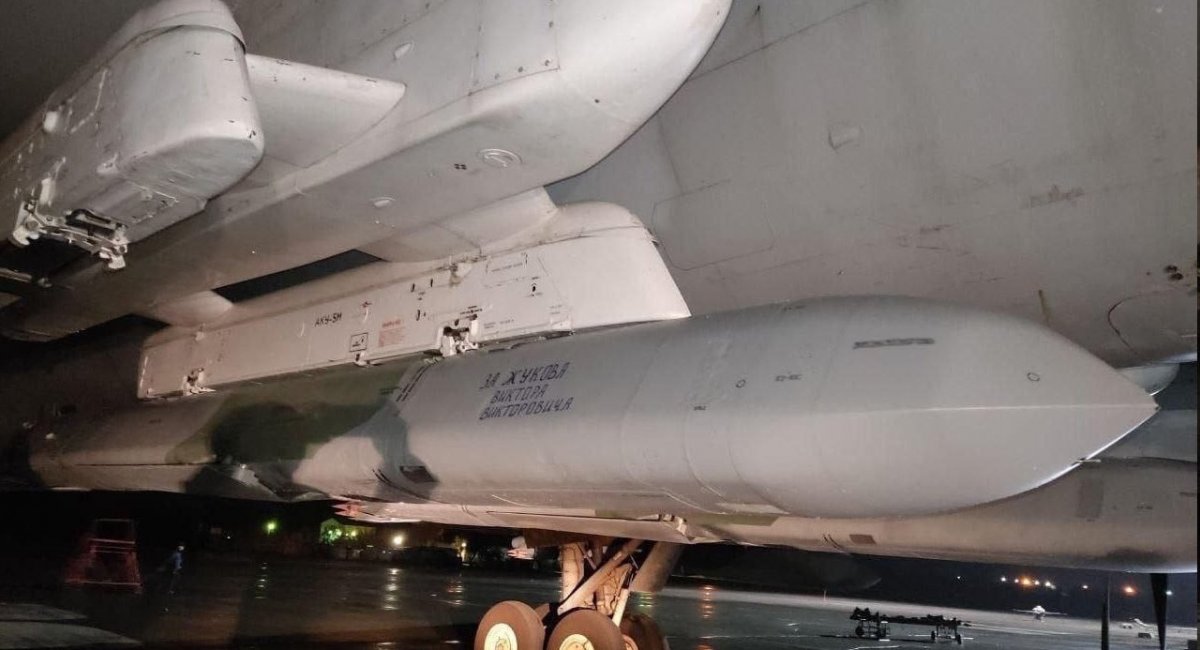
Take the Kh-101, for example, as the main missile for Russia’s strategic aviation. Over the course of the war, this subsonic cruise missile has gone through several iterations:
- The basic version, with which Russia began the full-scale invasion, was “Product 504”—a 400-kg warhead with an inertial guidance system.
- Since November 2022, Russia introduced the Kh-101 variant designated “Product 504AP.” This missile received infrared decoys to counter MANPADS, and to improve accuracy, it was equipped with the optoelectronic system “Otblesk-U,” which mimics the TERCOM system used on Tomahawks.
- In May 2023, there was information that Russia was planning to produce the Kh-50 as a simpler, mass-producible version of the Kh-101, but this was never confirmed.
- In 2024, the Russians deployed a new iteration of the Kh-101, this time with dual warheads:
- Conditionally “subvariant A” had a standard 400-kg warhead plus a 300-kg cluster warhead to target area-type objectives such as industrial facilities, energy infrastructure, and airfields.
- Conditionally “subvariant B” had two 400-kg warheads, increasing the total payload to 800 kg, at the cost of reduced range. This “matryoshka” configuration with two warheads was likely intended to increase the penetrative effect against fortified structures.
This description covers only the main “backbone” line of Russian improvements to the Kh-101, not including additional “patches.”
For example, there was an issue where, when Ukrainian air defense shot down a Kh-101, the warhead sometimes did not detonate and simply fell to the ground. At some point, the Russians began working to ensure that the warhead would detonate under any conditions, especially if the missile was intercepted (as far as I know, they have not achieved 100% success here).
All these details can seem very complex, and I’ve only skimmed the surface. Even I cannot say for certain which of the above Kh-101 “upgrades” Russia uses most frequently in strikes on Ukraine.
What is clear, however, is this illustrative point: for every missile type, Russia works to ensure that if the “product” reaches the target, it will cause maximum destruction—damage that takes a very long time to repair. That’s why, for example, power outages last so long after a missile strike.