

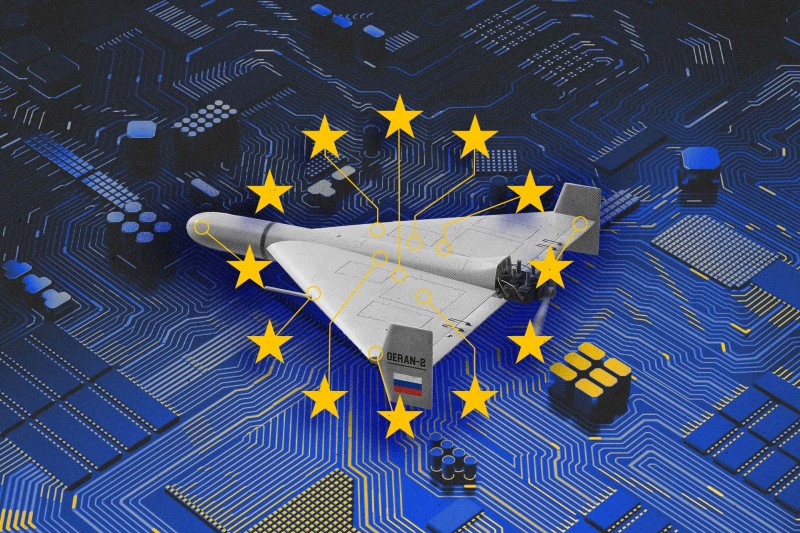
Despite strict sanctions and export controls, European technology remains a key component of Russia’s drone arsenal, which is used to strike Ukraine’s energy system and cities. A joint investigation by OCCRP, The Kyiv Independent, and partners found that Russian “Geran-2” drones (based on Iranian Shahed models) contain parts from at least 19 manufacturers across the EU and the UK.
Russia has managed to establish a continuous “death conveyor belt,” producing hundreds of drones each month, each containing on average 112 Western-made components. Journalists analyzed internal Russian documents and customs data, confirming that hundreds of critical components continue to reach Russia through complex intermediary networks.
Special attention in the investigation focused on the Polish company Zakłady Paliwowe (also known as Zakład Aparatury Paliwowej or ZAP). Researchers discovered that ZAP’s fuel pumps, manufactured in Bolesławiec, are critical parts of Geran engines, supplying fuel to the internal combustion engine and enabling long-distance flight. Russian engineers reportedly adapted drone designs specifically for these Polish pumps due to their reliability and availability. Despite Poland being a strong supporter of Ukraine, ZAP products continued reaching Russia via intermediaries. Company management stated that they do not sell directly to Russia and cannot control where distributors resell the pumps in third countries.
Other key suppliers include the Swiss company STMicroelectronics, whose microcontrollers and signal-processing chips appear in nearly every downed drone. Navigation systems heavily rely on modules from Swiss firm u-blox for precise GPS targeting. Dutch company NXP Semiconductors provides transceivers and processors for drone communications, while German firm Infineon Technologies supplies power transistors and voltage regulators essential for stable electronics operation. Although these companies have officially exited the Russian market, products manufactured in Malaysia, China, or the Philippines are freely purchased by Russian shell companies through Hong Kong intermediaries.
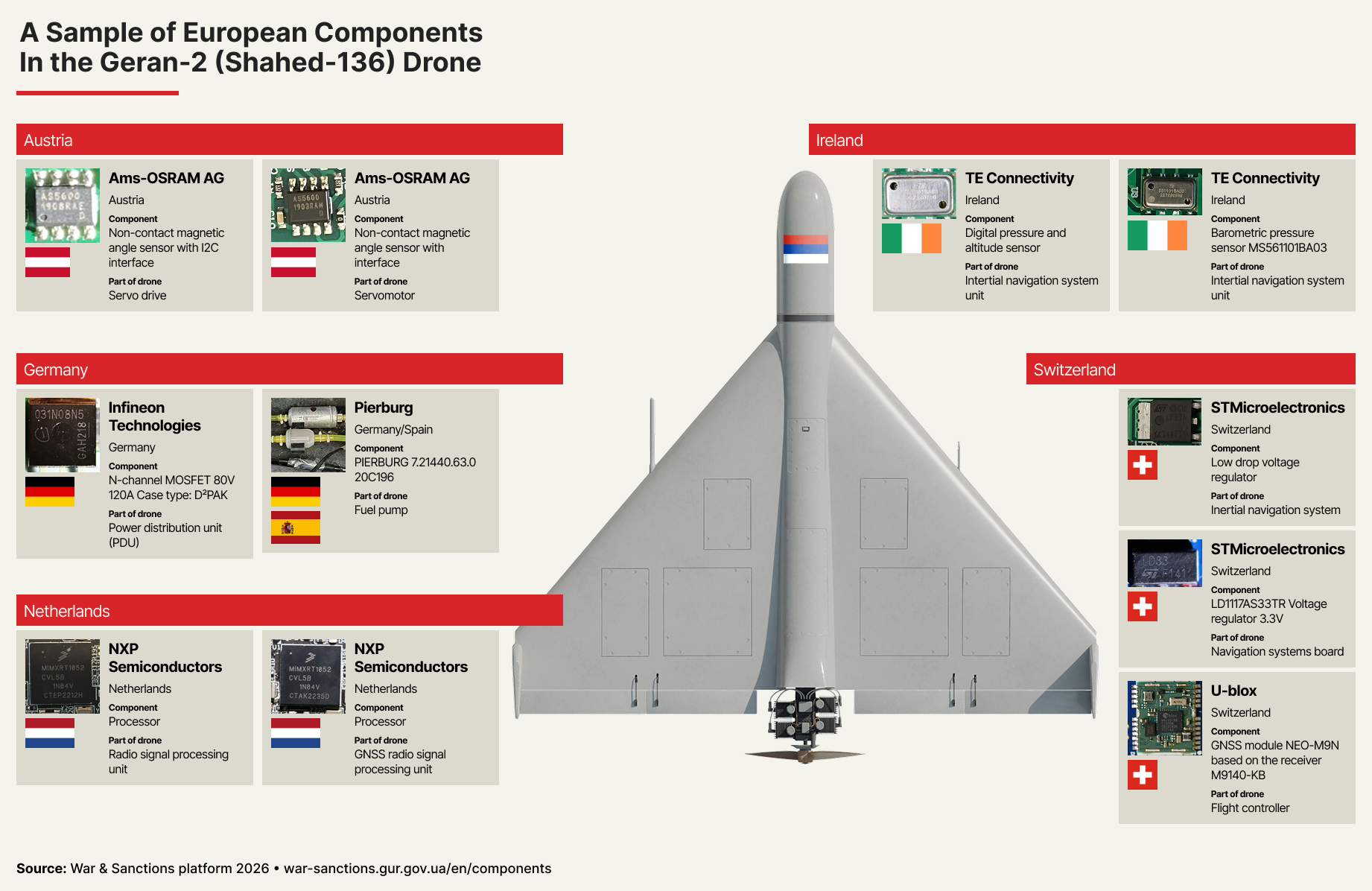
European components found in the Geran-2 drone by Ukraine’s military intelligence.
German company Bosch provides pressure and temperature sensors that adjust engine performance based on flight altitude. Irish Analog Devices and U.S.-based Texas Instruments (with large European facilities) supply analog signal processing components. UK-based FTDI provides interface chips allowing technicians to program flight missions directly into the drone’s memory. Other mentions include France’s Schneider Electric, whose components appear in electrical circuits, and Austria’s EPCOS (part of TDK), whose filters and capacitors protect electronics from interference.
Investigators traced financial flows, revealing that Russia spends hundreds of millions of euros on these components. Through a Hong Kong-based network connected to Alabuga, purchases exceeded €190 million in 2024 and 2025. Critical nodes in this supply chain included China, Turkey, the UAE, Serbia, and Kazakhstan. Often, components were disguised as spare parts for agricultural machinery or consumer electronics—for example, the same chips in Gerans are used in modern washing machines or car navigation systems, classifying them as dual-use goods and simplifying legal export from Europe.
Manufacturers such as Swiss ABB and German Siemens, whose parts were also found in Alabuga’s drone assembly facilities, claim strict compliance with sanctions. However, the investigation highlights a systemic issue: European companies are not responsible for the actions of their distributors in second- and third-tier networks, allowing Russian intelligence to create thousands of shell companies to acquire necessary components.
Ukrainian military experts note that without these 19 European suppliers, industrial-scale Geran production would be impossible, as Russian alternatives are too large, too energy-intensive, or simply nonexistent. Thus, even indirect European exports effectively support a conveyor that produces weapons used to attack civilians and critical infrastructure in Ukraine.