

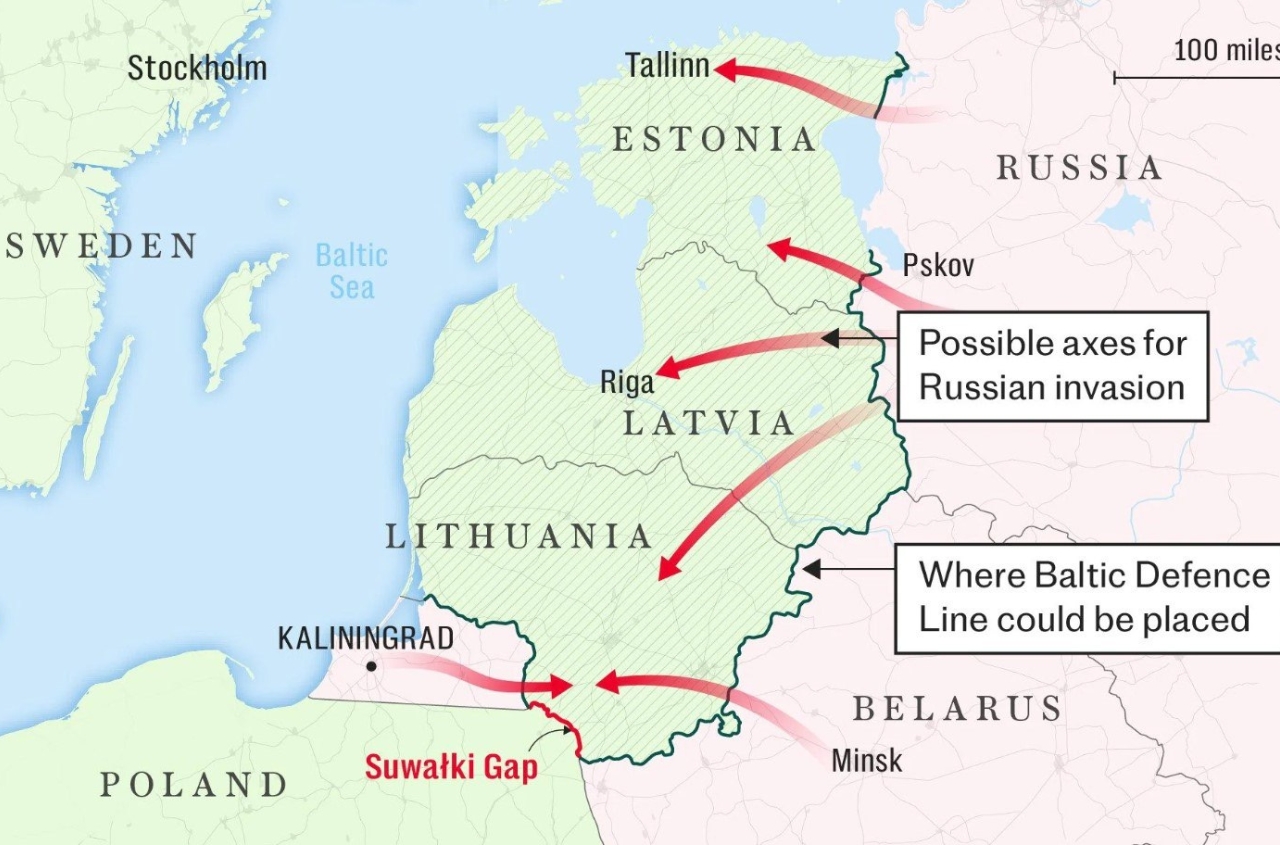

I’m going to show you now how to “properly” plan an attack on the Baltic states.
For this, we’ll need a globe and our hands — to trace routes on the globe while watching the movement of our hands.
Or, if there’s no globe, any map will do.
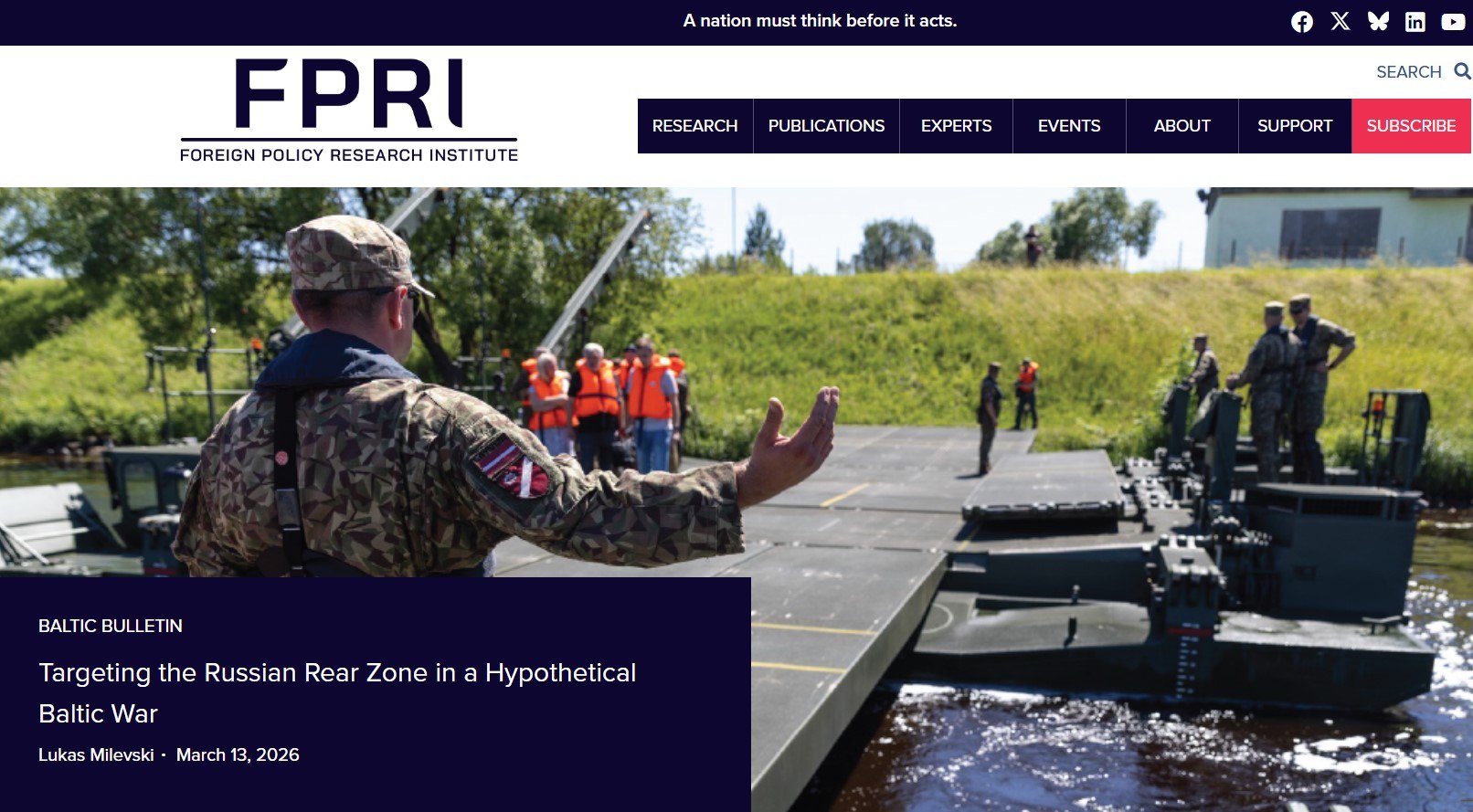
- On March 13, 2026, Associate Professor Lukasz Milewski of Leiden University (he holds American-Latvian citizenship) published an article on the website of the American think tank Foreign Policy Research Institute titled “Targeting the Russian Rear Zone in a Hypothetical Baltic War”, which includes a review of where one might strike up to 50 km deep to slow down a hypothetical advance of Russian forces into the Baltic states.
Materials like this are periodically produced by analysts and associate professors of various specialties because it’s their mission — to produce materials. Publish or perish!
The article lists, fairly thoroughly, roads and bridges along which Russian ground forces would hypothetically advance (without considering air or naval components) — that is, the bulk of the troops.
If you locate these routes on a map, they will match the image currently circulating online and being called the “fresh Bild map.” It’s very hard not to match it, because when you mark literally all directions, they align perfectly!
- If you take the “fresh Bild map” and simply search it on Google, you’ll see that this exact image has been circulating online since at least March 2024. Beyond that, I got too lazy to check. To make it seem new, different authors and media outlets occasionally move the legend around, but the essence doesn’t change.
- If you randomly Google something like “how Russia will invade the Baltic states” in foreign languages, you’ll get dozens of identical images, differing only in color schemes and arrow thickness, but not in substance.
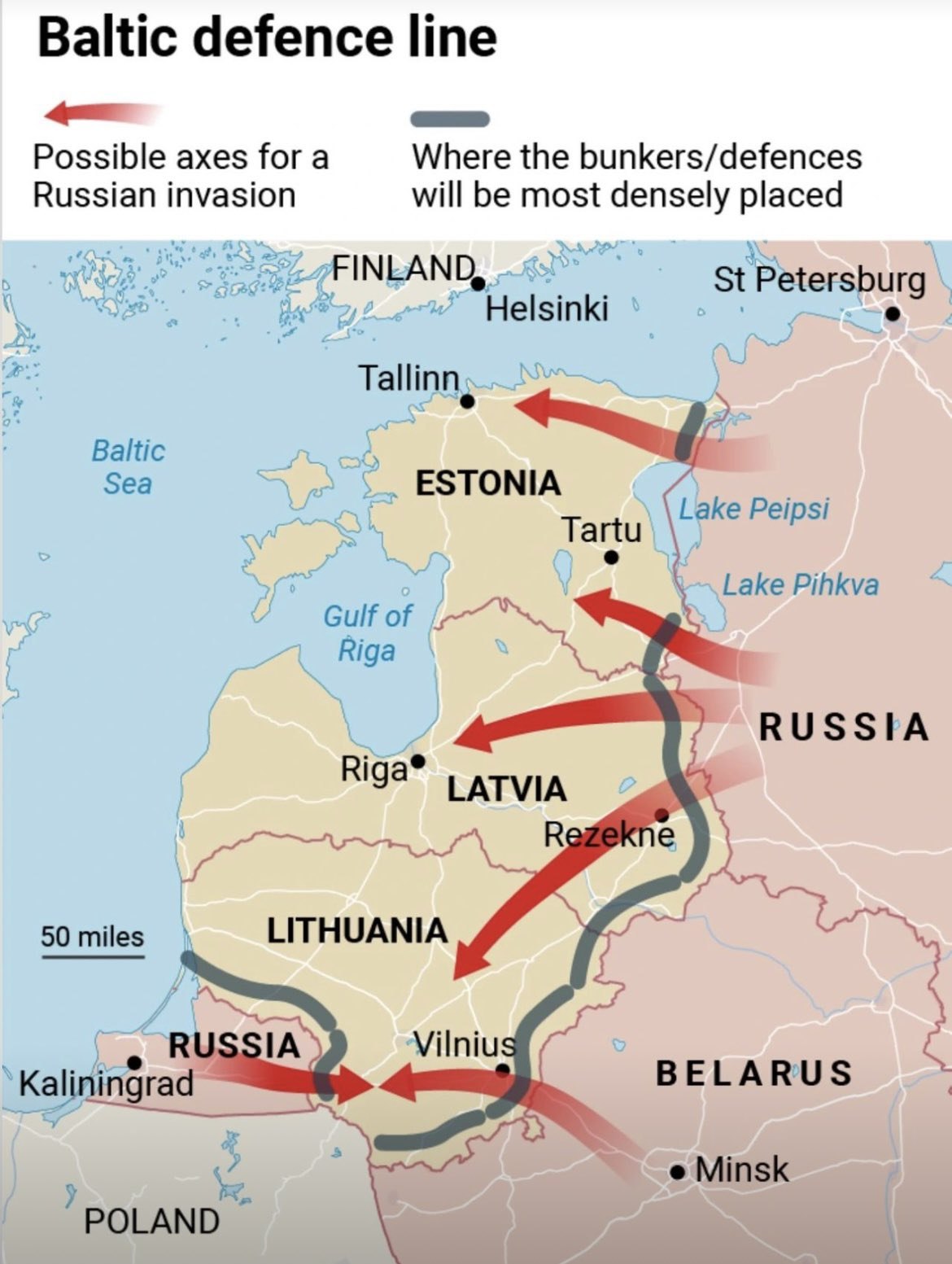
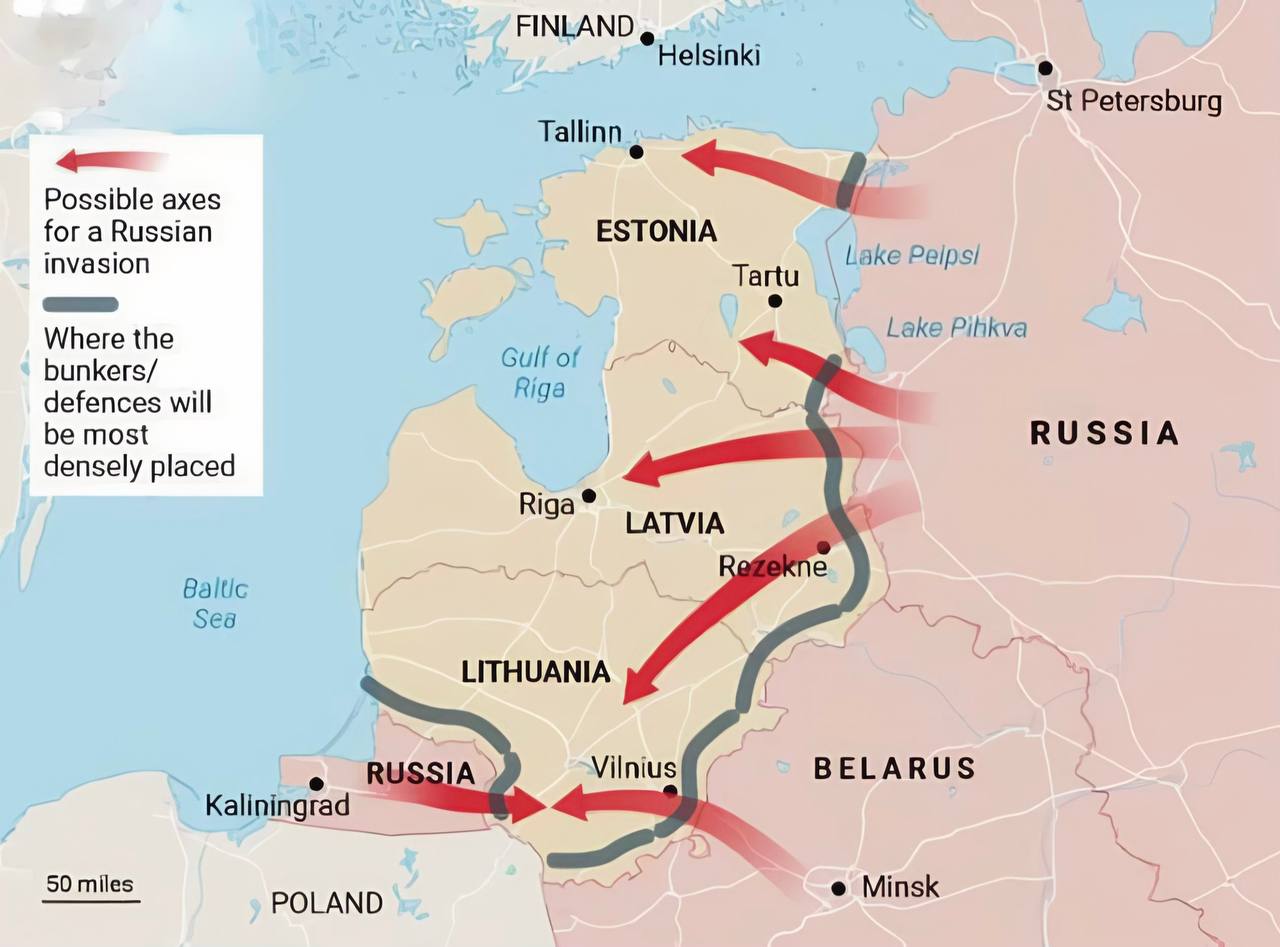
Using this method, I could draw “attack plans” maps for most countries in the world…
So, what’s the point?
It’s not about whether Russians have attack plans or not. It’s about the fact that this is not a revelation.
Dozens of scenarios have been outlined — from the “Narva Republic” to the “Suwałki Corridor,” complete with illustrations (see the Narva example in the image). Each scenario on paper has an if-then plan.
The main unknown here: if an attack occurs, what are the REALISTIC capabilities to repel aggression?
The approach described in the Leiden associate professor’s article is academically sound, but it relies on the Follow-on Forces Attack doctrine developed in the 1980s.
It doesn’t fully account for FPV drones operating calmly 20+ km deep. It doesn’t account for various Molniya, Shahed, Lancet, and other flying devices capable of seriously disrupting the capabilities of both attackers and defenders. Russians know how to use this technology well; NATO forces do so with varying success. Cyber capabilities are also uncertain.
The Baltic states have heavily fortified their borders and learned a lot from us (since it would have been a sin not to share). The question is how key NATO members will respond, who under an academic approach are expected to launch missile and air strikes DEEP into Russia, seize Kaliningrad, and deploy reinforcements — especially when Russia begins applying “salami tactics.” Not calling for negotiations, but striking.
I don’t want to get into a discussion now about the Russian bill on using troops to protect oppressed Russians, etc., because the essence doesn’t change.
In any scenario, Europe needs an ally capable of projecting force against Russia. There is no better option than Ukraine.
Therefore, attempts to delay funding and impose other limitations on Ukraine’s military capabilities are an obvious misunderstanding. It means Europe is not seriously treating Moscow as an adversary. Or Europe simply doesn’t care about the Baltic states and Poland. Otherwise, it can’t be explained…
The “ideal” way to prepare an attack on the Baltic states and Poland would be to weaken Ukraine’s defensive potential. Then it wouldn’t even be necessary to stop the war.