

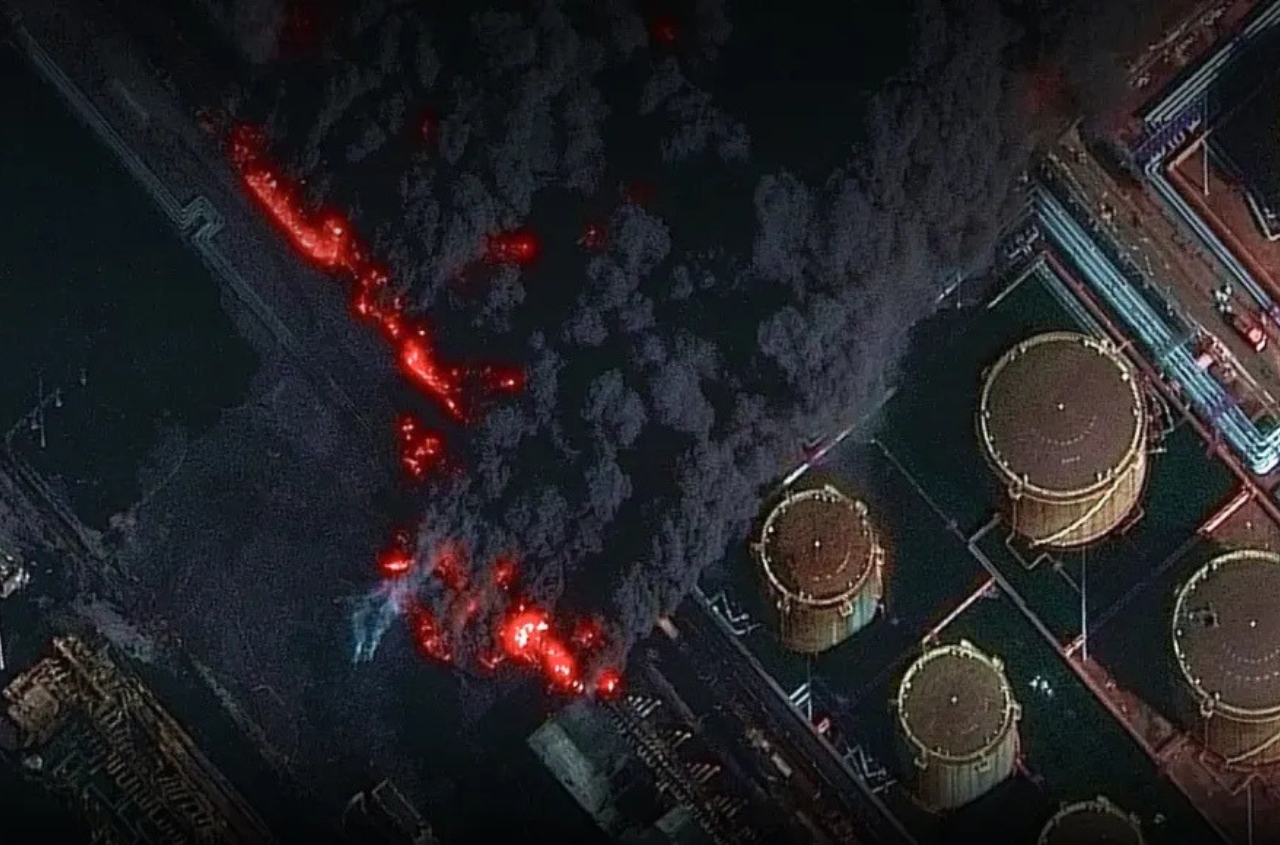

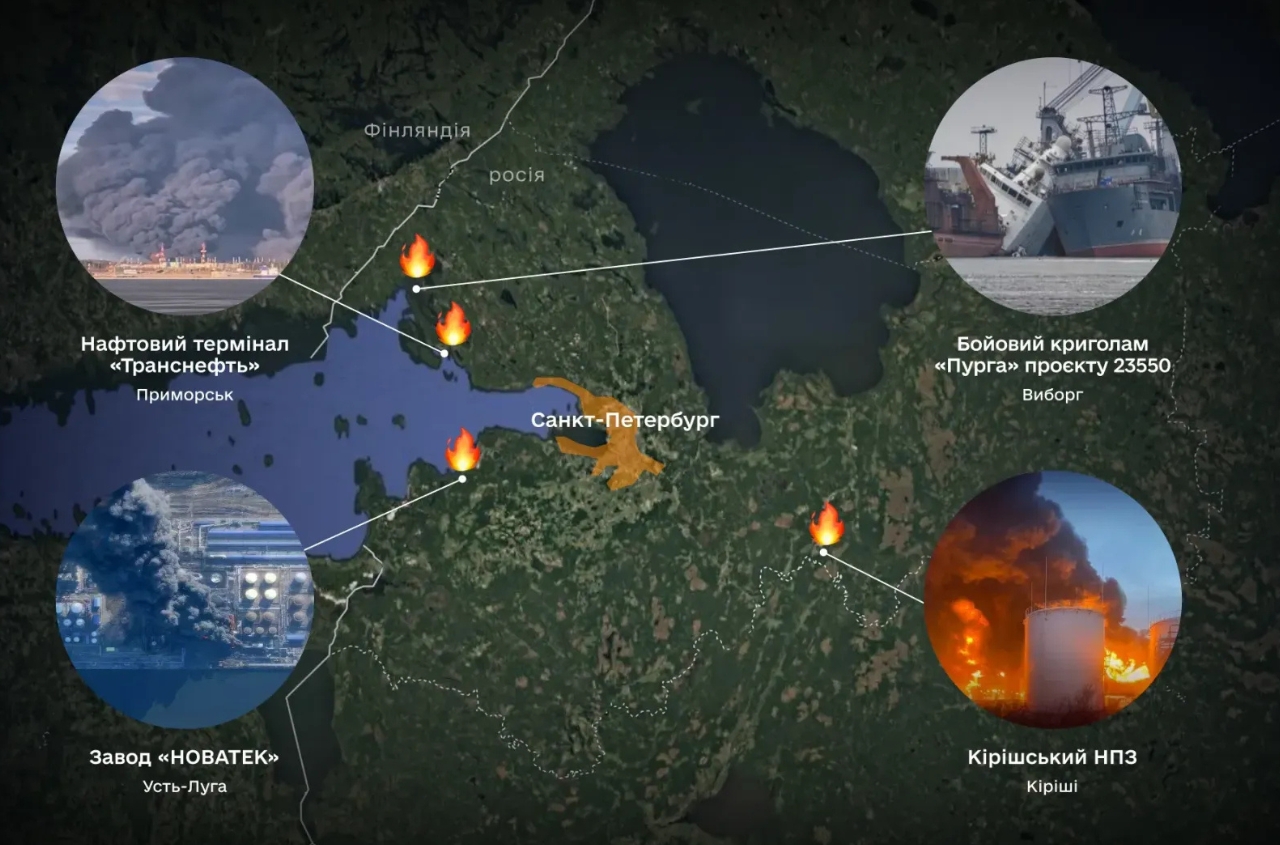
Over the past week, Ukraine’s Defense Forces have carried out comprehensive precision strikes on infrastructure in Russia’s Leningrad region, which finances the Russian troops’ war machine. As a result of hits on Russian ports in the Baltic, a significant portion of Russia’s oil exports has been blocked.
The Ministry of Defense of Ukraine reports which facilities were targeted and their significance for reducing the offensive capabilities of Russian forces under Ukraine’s War Plan.
KINEF Oil Refinery
On March 26, drones struck the primary oil processing units and two large storage tanks at the KINEF oil refinery in the city of Kirishi. A large-scale fire broke out at the facility, which could not be controlled for several hours.
Kirishi refinery is one of Russia’s three largest plants, with a capacity of about 21 million tons of oil per year (over 6% of Russia’s total refining capacity).
Hitting the primary processing units is a strike to the “heart” of the refinery. Without them, the subsequent technological chain halts. This not only disrupts oil exports but also directly affects the supply of fuel (diesel, aviation fuel) to Russian troops.
NOVATEK-Ust-Luga Plant
On March 24, Defense Forces struck the tank farm and the stenders — mechanical “arms” used to load fuel onto tankers — at the NOVATEK-Ust-Luga plant. Ukrainian drones traveled 900 kilometers to reach the target.
On the night of March 29, another strike hit this plant, causing serious damage and a fire.
Ust-Luga is the “gateway” for Russian exports on the Baltic. This largest Russian port on the Baltic Sea is a key point for exporting crude oil and petroleum products, including via shadow fleet vessels. Last year, Russia exported over 30 million metric tons of petroleum products through Ust-Luga. The plant processes stable gas condensate into high-value products (oil, kerosene, diesel) for export.
Damage to the stenders critically slows or completely stops fuel shipments for export, causing direct losses to Russia’s foreign currency earnings, which finance the Russian troops’ war efforts.
Transneft – Primorsk Oil Terminal
On March 22 and 23, Ukraine’s Defense Forces struck oil storage infrastructure at the Transneft – Primorsk terminal, resulting in heavy smoke and a fire.
It is the largest Baltic port for crude oil exports, handling up to 60 million tons per year.
Systematic strikes on such terminals force tankers to idle, increase shipping insurance costs, and force Russia to find complicated and expensive alternative routes around damaged hubs.
Vyborg Shipyard
On March 25, the patrol icebreaker “Purga” (Project 23550) was hit at the Vyborg shipyard.
This is not just an icebreaker but a hybrid military vessel armed with artillery and capable of carrying “Kalibr” or “Uran” missile containers. It was being prepared for the FSB Coast Guard.
Building and repairing ships of this class takes years. Taking “Purga” out of operation while still in dock is a painful blow to Russia’s ambitions to control Arctic and Baltic regions.
Systemic Bleeding of Russian Forces
One of Ukraine’s War Plan goals is to deprive Russian forces of the economic resources to wage war. In this context, the comprehensive strikes on Leningrad region oil infrastructure have three main effects:
- Economic: Blocking oil and petroleum exports via the Baltic deprives Russia’s budget of billions of dollars, which would otherwise be converted directly into rockets and shells.
- Logistical: Creates fuel shortages for Russian troops.
- Technological: Successful strikes over 900 km demonstrate Russia’s air defenses cannot protect critical infrastructure even deep in its rear.
Thus, the Baltic region has turned from a “safe hub” into a high-risk zone for Russian forces. Systematic destruction of oil infrastructure via deep strikes exhausts Russian troops’ resources and creates long-term obstacles to restoring their military potential in the future.