


By Gilles Bader for La Provence
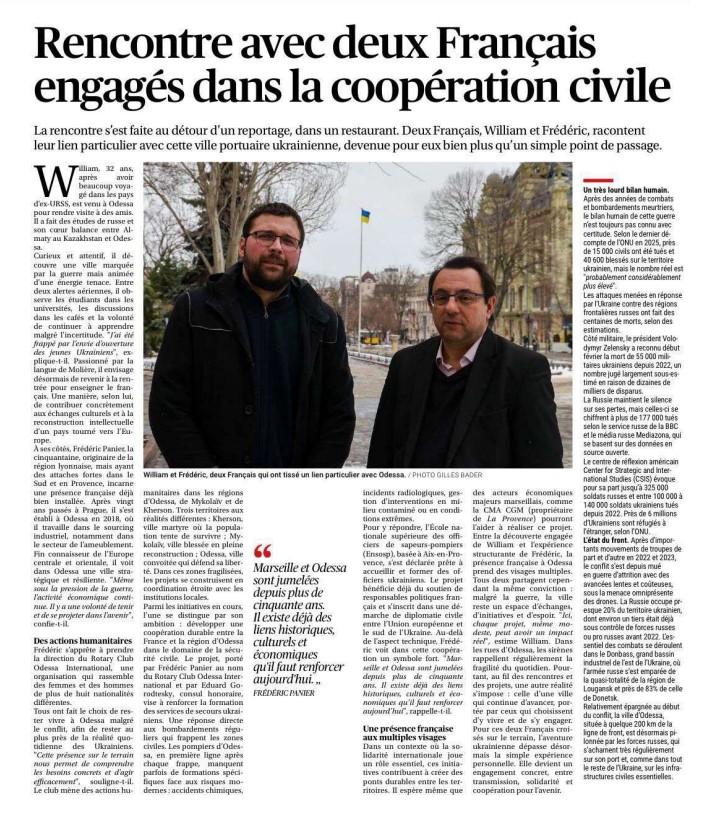
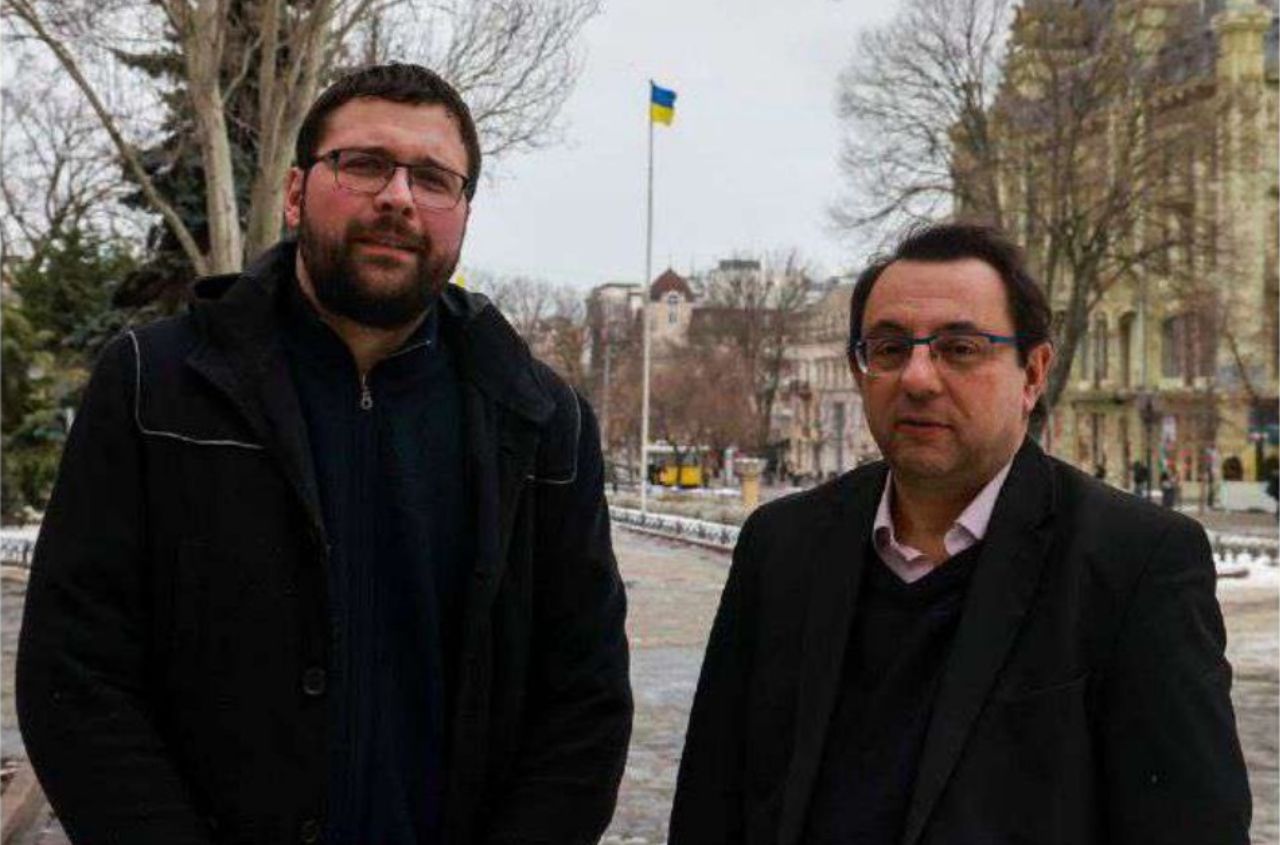
The meeting took place by chance during a report, in a restaurant. Two Frenchmen, William and Frédéric, share their special connection with this Ukrainian port city, which has become for them much more than a simple stopover.
William, 32, who has traveled extensively in former USSR countries, came to Odessa to visit friends. He studied Russian, and his heart is torn between Almaty in Kazakhstan and Odessa. Curious and attentive, he discovers a city marked by war but animated by a resilient energy. Between air raid alerts, he observes students at universities, conversations in cafés, and the determination to keep learning despite uncertainty.
“I was struck by the openness of young Ukrainians,” he explains.
Passionate about the language of Molière, he now plans to return in the fall to teach French. For him, this is a way to contribute concretely to cultural exchange and to the intellectual reconstruction of a country oriented toward Europe.
Beside him, Frédéric Panier, in his fifties, originally from the Lyon region but with strong ties to the South and Provence, represents an already well-established French presence. After twenty years in Prague, he settled in Odessa in 2018, where he works in industrial sourcing, particularly in the furniture sector. A knowledgeable observer of Central and Eastern Europe, he sees Odessa as a strategic and resilient city.
“Even under the pressure of war, economic activity continues. There is a will to endure and to look toward the future,” he says.
Humanitarian initiatives
Frédéric is preparing to assume the presidency of the Rotary Club Odessa International, an organization bringing together men and women from more than eight different nationalities. All have chosen to remain in Odessa despite the conflict, in order to stay close to the daily realities of Ukrainians.
“This presence on the ground allows us to understand concrete needs and act effectively,” he emphasizes.
The club carries out humanitarian actions in the Odessa, Mykolaiv, and Kherson regions—three areas with very different realities: Kherson, a martyr city where the population struggles to survive; Mykolaiv, a wounded city in the midst of reconstruction; Odessa, a coveted city defending its freedom. In these fragile areas, projects are built in close coordination with local institutions.
Among the ongoing initiatives, one stands out for its ambition: developing sustainable cooperation between France and the Odessa region in the field of civil security. The project, led by Frédéric Panier on behalf of the Rotary Club Odessa International and by Eduard Gorodetsky, honorary French consul, aims to strengthen the training of Ukrainian emergency services. This is a direct response to the regular bombardments affecting civilian areas. Odessa firefighters, on the front lines after each strike, sometimes lack specialized training to face modern risks: chemical accidents, radiological incidents, managing interventions in contaminated environments, or in extreme conditions. To address this, the National School of Fire Officers (Ensosp), based in Aix-en-Provence, has declared itself ready to host and train Ukrainian officers. The project already enjoys the support of French political leaders and fits within a framework of civil diplomacy between the European Union and southern Ukraine. Beyond the technical aspect, Frédéric sees this cooperation as a powerful symbol.
“Marseille and Odessa have been twinned for more than fifty years. There are already historical, cultural, and economic ties that must be strengthened today,” he emphasizes.
A multifaceted French presence
In a context where international solidarity plays a crucial role, these initiatives help create lasting bridges between regions. Frédéric hopes that major economic players from Marseille, such as CMA CGM (owner of La Provence), may help him realize this project. Between William’s engaged exploration and Frédéric’s structuring experience, the French presence in Odessa takes on multiple forms. Yet both share the same conviction: despite the war, the city remains a space of initiative and hope.
“Here, every project, even modest, can have a real impact,” William believes.
In the streets of Odessa, sirens regularly remind residents of daily fragility. Yet, through encounters and projects, another reality emerges: that of a city that continues moving forward, supported by those who choose to live and invest themselves there. For these two Frenchmen met on the ground, the Ukrainian adventure has gone beyond a personal experience. It has become a concrete commitment—one of transmission, solidarity, and cooperation for the future.