

Ukraine is the first country in the world to develop evacuation unmanned aerial vehicles (UAVs) capable of rescuing military personnel in situations where ground evacuation is impossible.
This year, Ukrainian forces have already carried out what is described as the world's first medical evacuation using a heavy-lift drone. They subsequently successfully tested a drone that returned with wounded soldiers despite Russian electronic warfare (EW) interference, using artificial intelligence (AI)-based navigation.
The Brave1 defence innovation cluster, with the support of Ukraine's Ministry of Defence, is working to develop evacuation UAV capabilities.
Advantages of aerial evacuation drones
In modern warfare, conventional evacuation methods are often unavailable due to the widespread use of drones. As a result, unmanned ground vehicles (UGVs) have become the primary means of rescuing military personnel. They successfully evacuate soldiers from dangerous areas but have limitations in terms of speed. For a critically wounded soldier, however, any delay can be fatal.
When every minute counts and all ground routes are mined or cut off by Russian forces, evacuation by air may be the only remaining option. This is where heavy-lift aerial drones can play a crucial role.
Requirements for evacuation drone manufacturers
In 2024, Brave1, together with the military, identified operational requirements and initiated the development of a new category of technology: evacuation drones.
The following criteria were established for the defence technology industry:
- The aircraft must be capable of reliably carrying a 130 kg payload over a distance of at least 15 km.
- To operate under electronic warfare conditions, drones must have an integrated communications system with at least three alternative communication methods.
Optionally, these drones may be equipped with LiDAR sensors, optical stabilisation systems and GPS-independent navigation.
Successful evacuations using drones
In October 2026, the Armed Forces of Ukraine carried out what was reported to be the world's first medical evacuation using a heavy-lift drone. An infantryman from the 30th Separate Mechanised Brigade was rescued from a position cut off by Russian forces.
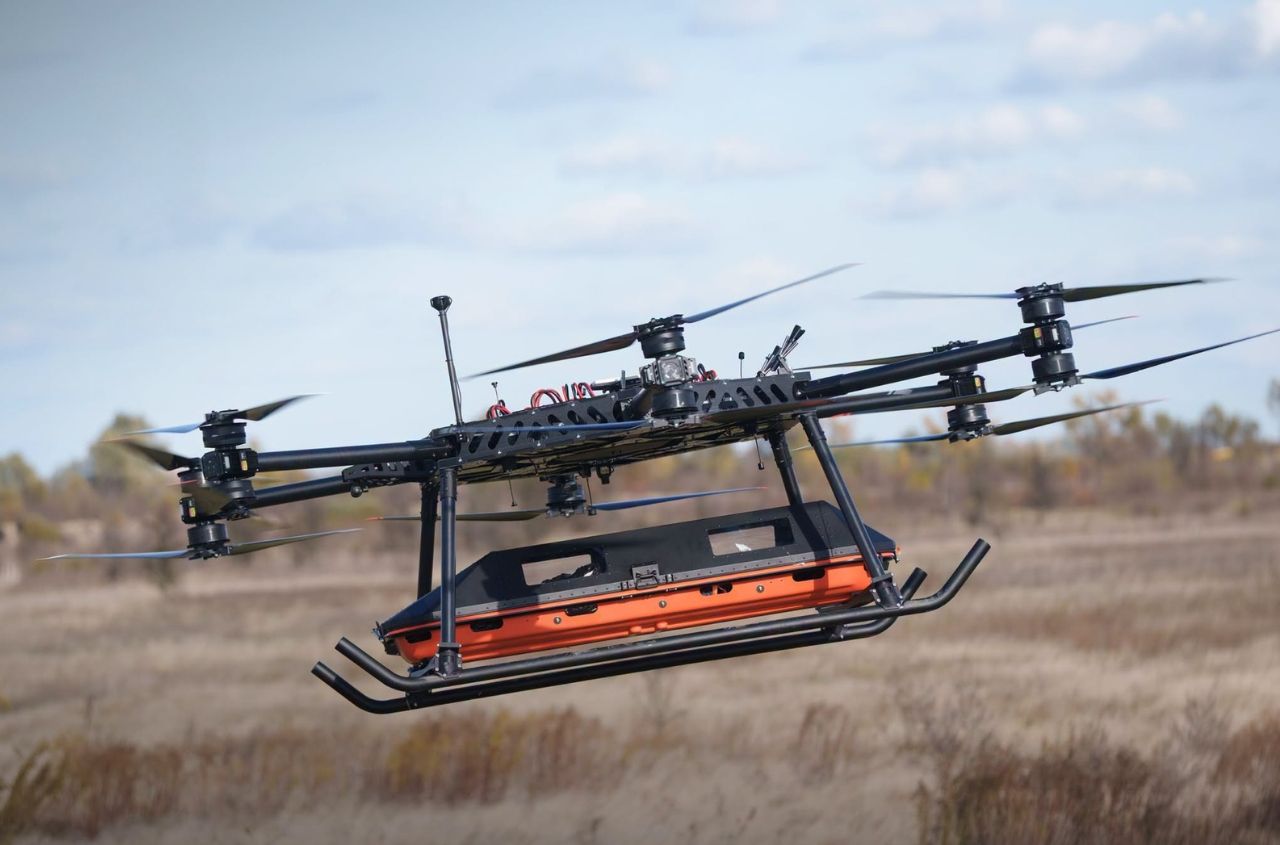
The operation was conducted using the Heavy Shot Ayudag-6 hexacopter, developed by a Brave1 participant. The aircraft weighs 98 kg and has a payload capacity of 130 kg. During this mission, it travelled more than 15 km in one direction.
Preparations for the mission lasted several months and incorporated the experience of the unmanned ground vehicle company of the 92nd Separate Assault Brigade.
Evacuation equipment was dropped to the soldier in advance, allowing him to attach himself to the drone's winch. During the evacuation itself, neighbouring units deployed their heavy bomber drones to divert Russian interceptor drones away from the rescue aircraft.
Recently, a Ukrainian company participating in Brave1 unveiled the Stargate system, the first drone designed specifically for evacuation missions in response to requests from assault troops.
The aircraft can be deployed within 10 minutes, carry a payload of 150 kg at speeds of up to 105 km/h, and is equipped with a medical module containing a stretcher.
Thanks to AI-based software, the drone can independently calculate a route and return to a safe area even if its navigation signals are completely jammed.
Using this drone, assault troops from the CODE 9.2 Regiment carried out two successful aerial evacuations of seriously wounded soldiers from the grey zone within a single week.
The soldiers were located 5 km from the Russian border, where difficult terrain, water obstacles and the threat of FPV drones made ground evacuation impossible.
The drone flew almost 30 km in one direction and returned with the wounded soldiers on board despite Russian electronic warfare interference, relying entirely on AI-powered navigation.
The operation was covered by heavy attack drones, which conducted intensive strikes to suppress Russian positions.