

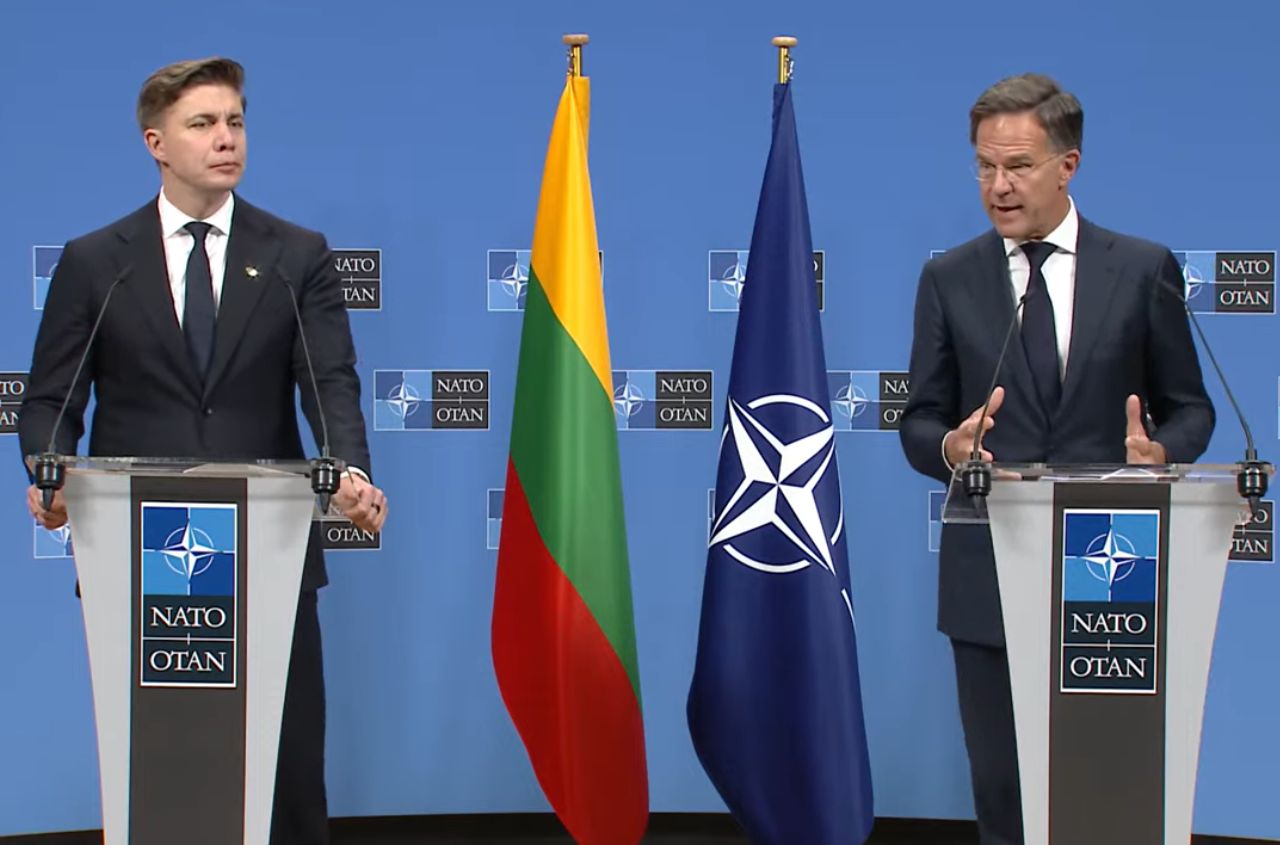
NATO Secretary General Mark Rutte said the Alliance’s responses to Russian hybrid attacks are not always public or based on a “tit-for-tat” approach.
Rutte made the remarks during a joint press conference with Lithuanian Prime Minister Mindaugas Sinkevičius at NATO headquarters in Brussels.
“When it comes to the word ‘hybrid’, I have said many times that it sounds somewhat soft and innocent. Ultimately, we are talking about grey-zone tactics. These can include drones, sabotage or even cyberattacks,” Rutte said.
He stressed that NATO has all the necessary response options available.
“You will not always see them publicly. They will not always be symmetrical. It will not always be tit-for-tat, but we have the response options we need,” the NATO Secretary General said.
As an example of a symmetrical response, Rutte pointed to NATO’s launch of the Baltic Sentry operation to protect critical undersea infrastructure after a cable between Finland and Estonia was damaged in late 2025.
As an example of an asymmetric response, he cited measures taken by allies including Sweden, the United Kingdom, Belgium and France to make it more difficult for Russia’s “shadow fleet” to operate and prevent what he described as “rusty tankers” from generating revenue for Russia.
Rutte also argued for a measured approach to responding to Russian provocations, noting that NATO is dealing with a Kremlin leadership that, he said, has already sacrificed the lives of up to 1.2 million of its own troops in a “completely unprovoked war”.
“So a certain degree of measuredness is appropriate, but at the same time we must continue investing in defence, as the Lithuanian government and other NATO countries are doing,” Rutte said, calling on allies to continue strengthening the Alliance.
He also welcomed the recent interception of a drone over Lithuania by Italian fighter jets as part of NATO’s air defence mission.
Rutte stressed that continued support for Ukraine is another important element of NATO’s response to Russia.
“The best response to anything Russia does in this ‘grey zone’ is to increase, not decrease, support for Ukraine. Because ultimately their aim is to divide us, make us lose focus on Ukraine and start debating among ourselves about what is happening, why it is happening and how these events are connected,” he said.
“Our signal to Moscow is clear. We will do more for Ukraine, not less,” Rutte concluded.