

A fierce struggle has unfolded within the Russian Orthodox Church (ROC) and Russia’s political elite over control of the ROC as the Russian Federation’s primary ideological institution, according to the Robert Lansing Institute. The current leadership of the Moscow Patriarchate is said to be losing influence amid persistent rumors about the health of its head, extensive reshuffles within the episcopate, and a series of high-profile corruption scandals.
The 79-year-old head of the ROC, Patriarch Kirill (Vladimir Gundyayev), has long been one of the most influential pillars of Russia’s political system. However, recent reports suggesting a possible decline in his cognitive abilities have raised questions about the future leadership of the Church and its relationship with the Kremlin. Observers of church affairs increasingly point to signs of age-related deterioration in the patriarch’s health. In particular, speculation intensified sharply in April 2026 when, during a Holy Week broadcast, Kirill reportedly confused major Orthodox holidays, beginning to speak about Christmas and Epiphany before his aides intervened.
Russian church analyst Ksenia Luchenko has stated that discussions among clergy and individuals close to the patriarch increasingly mention memory lapses, age-related personality changes, and even rapidly progressing dementia. Several Russian Telegram channels and émigré media outlets have also reported that Kirill’s entourage attempted to obtain advanced imported anti-Alzheimer’s medications, such as Leqembi (lecanemab), through Swiss medical networks, although Switzerland ultimately approved a competing drug, Kisunla (donanemab), instead.
The Moscow Patriarchate, however, has provided no official medical documentation and continues to publish reports showing Kirill’s regular participation in public events and international correspondence.
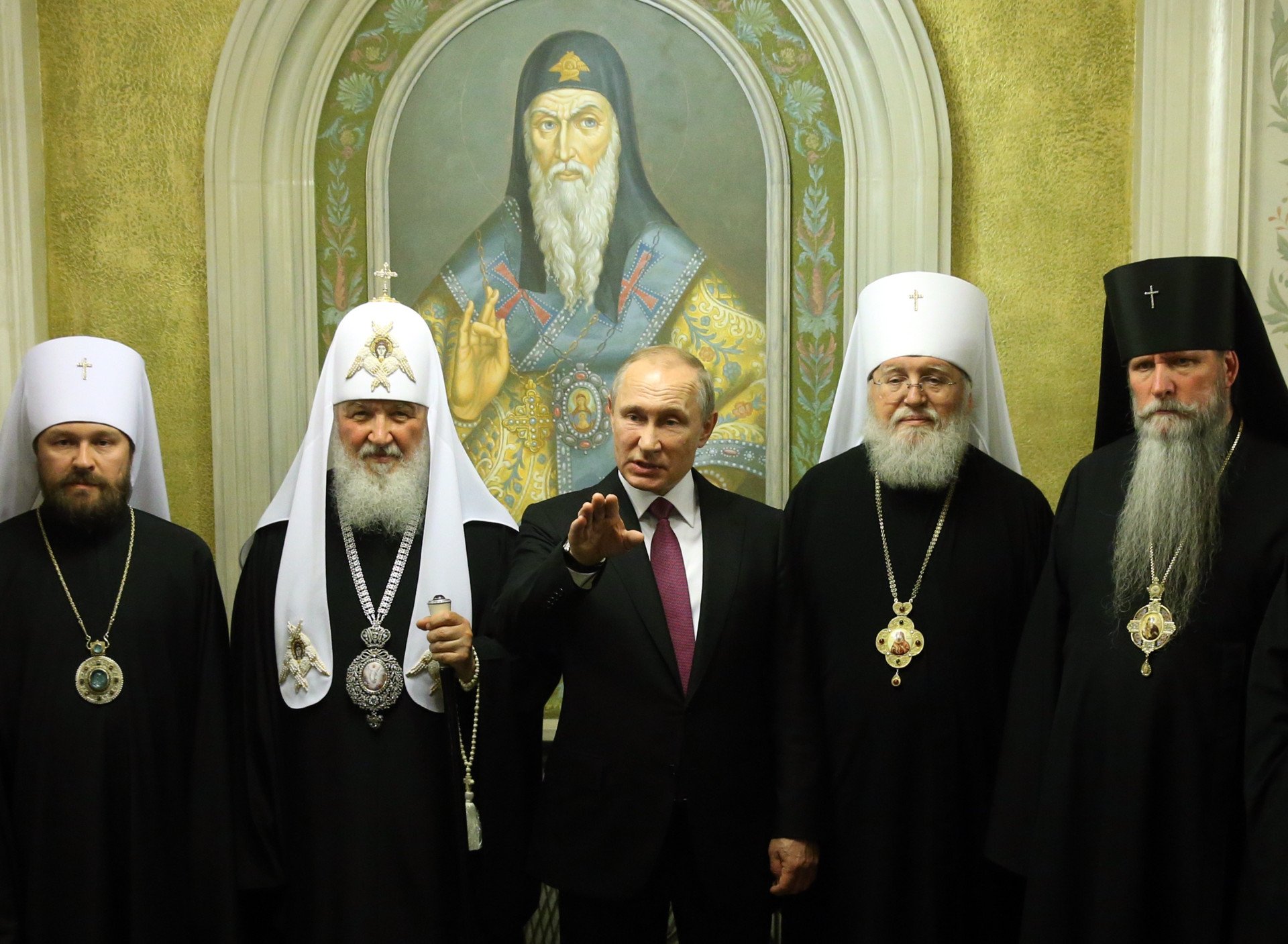
Experts emphasize that the patriarch’s health is of enormous strategic importance because, since 2022, the ROC has become one of the Kremlin’s principal instruments for legitimizing the war against Ukraine. Kirill has personally promoted the doctrine of the “Russian World,” portraying military actions as a sacred mission and a spiritual struggle.
Any change in leadership within the ROC directly affects Russia’s national security interests, as the Church provides mobilization narratives, influence operations abroad, management of domestic social networks, and soft-power mechanisms throughout the post-Soviet space. Against this backdrop, the struggle over the post-Kirill era has intensified amid a series of internal upheavals.
The most prominent case involves Metropolitan Hilarion (Alfeyev), who for years served as the ROC’s leading international representative and was widely viewed as the patriarch’s most likely successor. In June 2026, narcotics were reportedly found in a vehicle linked to Hilarion, after which he was urgently reassigned to little-known parishes in Brazil. The incident dealt a severe blow to the hierarchy’s reputation and significantly reduced the number of Kremlin-approved succession candidates.
In addition, investigative journalists reported in late 2025 that Patriarch Kirill, despite the episcopal requirement of celibacy, had allegedly maintained a long-term secret relationship with a woman named Lidia Leonova, who has been linked to extensive high-end real estate holdings. Together with ongoing allegations of opaque financial dealings, luxurious lifestyles among senior clergy, and questionable ownership of expensive properties, these scandals have seriously undermined the Church’s moral authority within Russian society.
Analysts note that rumors about the patriarch’s dementia and expensive treatment abroad may themselves be part of a coordinated information campaign designed to weaken Kirill’s authority ahead of a controlled transition of power. In Russian political tradition, leaks about a leader’s health have often preceded major personnel changes, as occurred with Boris Yeltsin in the late 1990s, Leonid Brezhnev during the late Soviet period, and Ramzan Kadyrov in recent years.
Three major factions are reportedly competing for influence over church revenues, episcopal appointments, and access to Vladimir Putin.
The first is a radical ideological faction closely linked to state security structures and advocating the expansion of the “holy war” concept and deeper integration of Church and state.
The second is an administrative-technocratic faction focused on preserving institutional stability, limiting financial damage, and improving relations with foreign churches without embracing excessive radicalism.
The third is a security-state faction backed by the presidential administration and intelligence services, whose priority is ensuring the absolute political reliability of ROC leadership and maintaining strict oversight of religious institutions.
At the same time, active preparations for a future transfer of power are already underway within the Patriarchate, as evidenced by a series of disciplinary actions and episcopal reassignments. On June 11, 2025, the Supreme Church Court imposed severe administrative sanctions on Bishop Kallinik over alleged financial misconduct, and Patriarch Kirill personally approved the decision on July 16. On July 24, the Holy Synod removed Kallinik from diocesan administration and transferred him to monastic duties.
Later, on October 30 and December 26, 2025, ROC leadership carried out additional episcopal appointments, including in North America, creating a loyal pool of younger hierarchs. The purge continued in spring 2026: on March 12–13, Bishop Seraphim was demonstratively removed as chairman of the Synodal Youth Department and demoted, while on May 14 the Holy Synod implemented another major round of diocesan personnel changes.
Experts argue that these measures are intended to sideline bishops connected to older patronage networks and centralize authority around Kirill and a narrow circle of senior metropolitans.
Particular attention from Russia’s security services is reportedly focused on Metropolitan Anthony, Metropolitan Gregory, and Metropolitan Benjamin, whose growing prominence within the Synod is viewed as a key sign of preparations for a managed transition of power.
The most likely scenario, according to analysts, is that Kirill will remain the nominal head of the ROC while real authority is gradually transferred to a successor fully approved by the Russian presidential administration. However, if the patriarch’s health deteriorates too rapidly or new corruption scandals trigger a deeper institutional crisis, an open clash between elite factions within the Church could ultimately deprive the Kremlin of one of its most important sources of political legitimacy.