



Ukrainian Neptune missiles have reportedly struck several high-value military and industrial targets in Russia over the past three months, including naval facilities, airbases, chemical plants and military electronics manufacturers.
An infographic compiled by OSINT analyst Special Kherson Cat documents eight reported strikes between 12 August and 7 November.
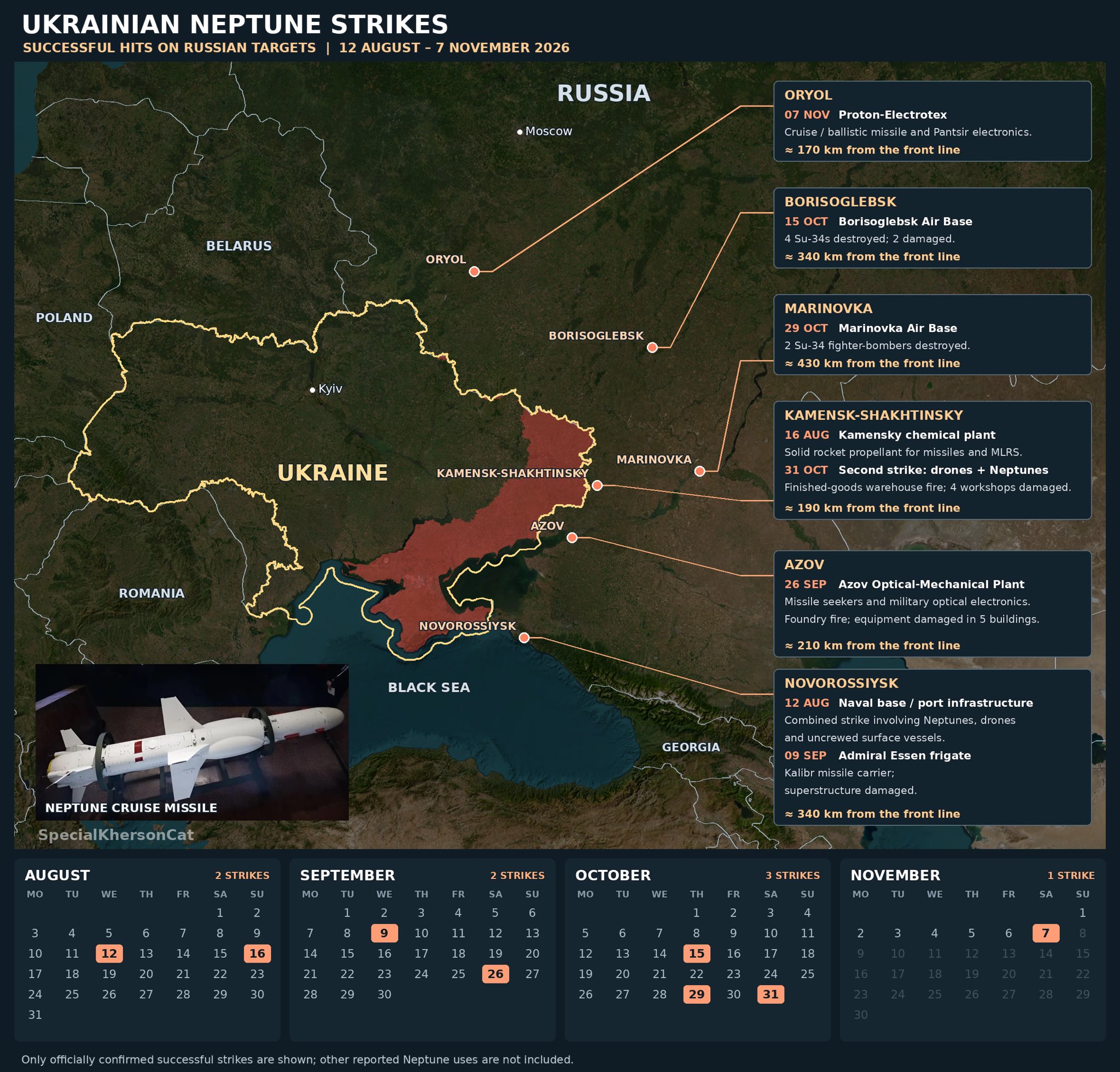
On 12 August and 9 September, Neptune missiles reportedly targeted Novorossiysk, damaging port and naval base infrastructure as well as the Russian frigate Admiral Essen.
A strike on 26 September targeted an optical-mechanical plant in Azov, where five buildings were reportedly damaged.
The chemical plant in Kamensk-Shakhtinsky, Rostov region, was targeted twice, on 16 August and 31 October. The facility produces fuel used in rocket propellants.
Russian military aviation was also targeted. Strikes on Borisoglebsk airbase on 15 October and Marinovka airbase on 29 October may have destroyed six Su-34 fighter-bombers and damaged two others, according to the assessment.
The most recent reported strike took place on 7 November, when Neptune cruise missiles targeted the Proton military electronics plant in Oryol.
Proton-Electrotex JSC was established in 1996 using the production facilities and workshops of the Soviet-era Proton plant. The company specialises in the development and manufacture of power semiconductor devices, including diodes, thyristors, IGBT modules, drivers and cooling systems. The strike hit the microelectronics production workshop.
Originally developed as an anti-ship missile, Ukraine's Neptune has been adapted for strikes against land-based targets, expanding its role in attacks on Russian military infrastructure.