

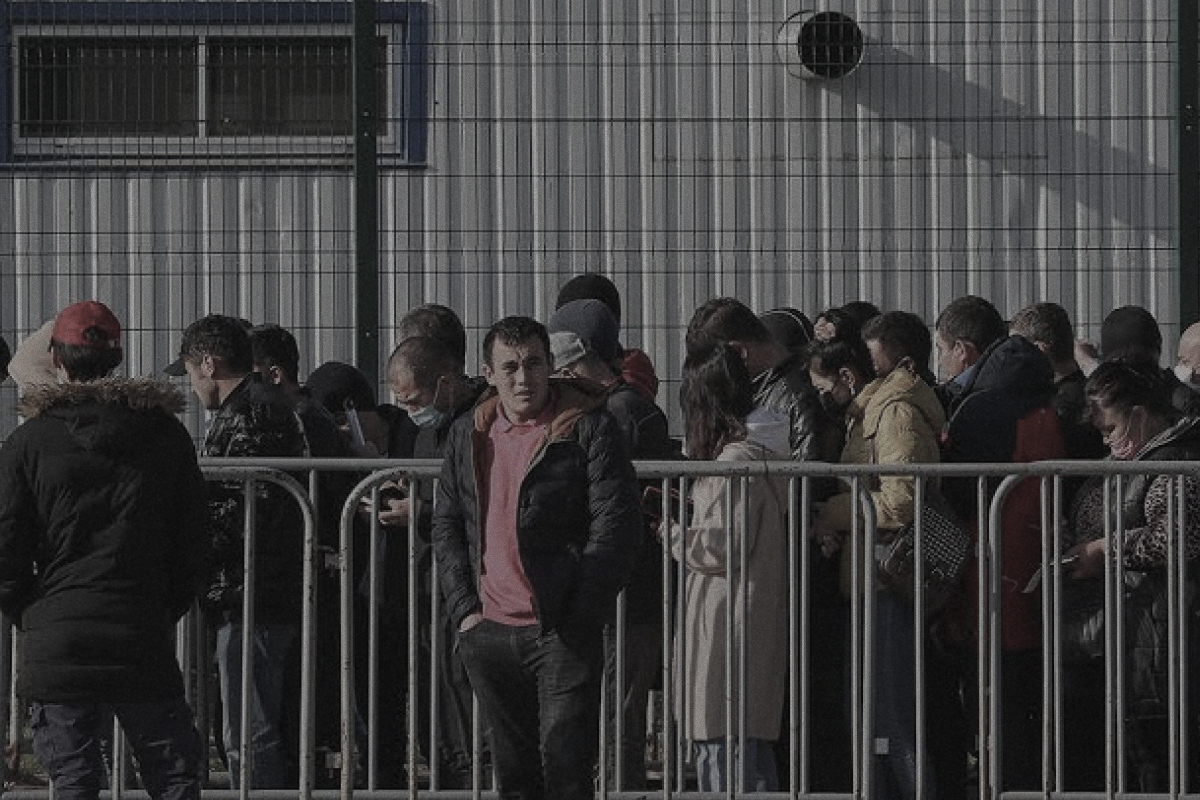
The Kremlin has spent years cynically convincing society that the state respects privacy and “does not monitor anyone.” However, another decision by Russia’s Interior Ministry disproves these claims: migrants will be required to purchase mobile phones with electronic profiles. The direct and sole purpose of this measure is total control and round-the-clock tracking of the geolocation of every person entering the country.
The introduction of mandatory tracking devices for foreigners demonstrates that Russian security services already have a ready and functioning infrastructure for mass surveillance. If the repressive system is capable of monitoring the movements of millions of visitors in real time, then Russian citizens are also under the same invisible surveillance. The Russian authorities have long been collecting geolocation data of their own population through state-controlled mobile operators and domestic software. Migrants have simply become the first group for which such monitoring is being officially enshrined in law, without any attempt to hide the authoritarian nature of the system.
A “technological prison” is already being tested at full scale in Moscow and the Moscow region through the mobile application “Amina.” Foreign nationals are required to keep geolocation tracking permanently enabled. If the application fails to transmit coordinates for three consecutive days, a person is automatically added to the so-called register of controlled individuals. The consequences are immediate and severe: bank card blocking, a ban on financial transactions, and mandatory deportation. Russian officials cynically call this “care,” while in reality it functions as a digital collar.
At the same time, Russia’s State Duma has significantly tightened legislation, turning the stay of foreign workers into a constant struggle under administrative pressure. Tax authorities will now automatically transfer information about migrants’ earnings to the Interior Ministry every three months, while foreign workers themselves must submit annual income declarations. Any failure to meet the required criteria — such as an insufficient period of employment or income below the minimum subsistence level — will result in the immediate cancellation of residence permits or legal status. Migrants and their families will have only 15 days to leave the country.
These repressive measures also directly affect migrants’ children, highlighting the lack of humanitarian considerations in Russia’s migration policy. Minors may remain in Russia only for the duration of their parents’ work permits. Once they turn 18, children of migrants must either immediately obtain their own employment permits or leave Russian territory within one month.