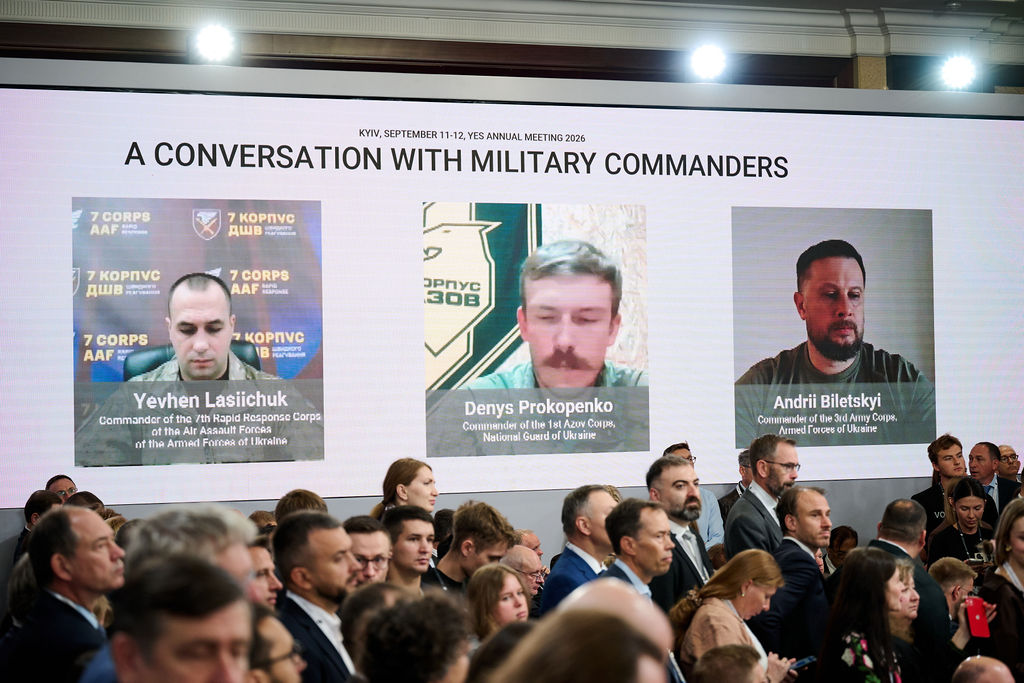


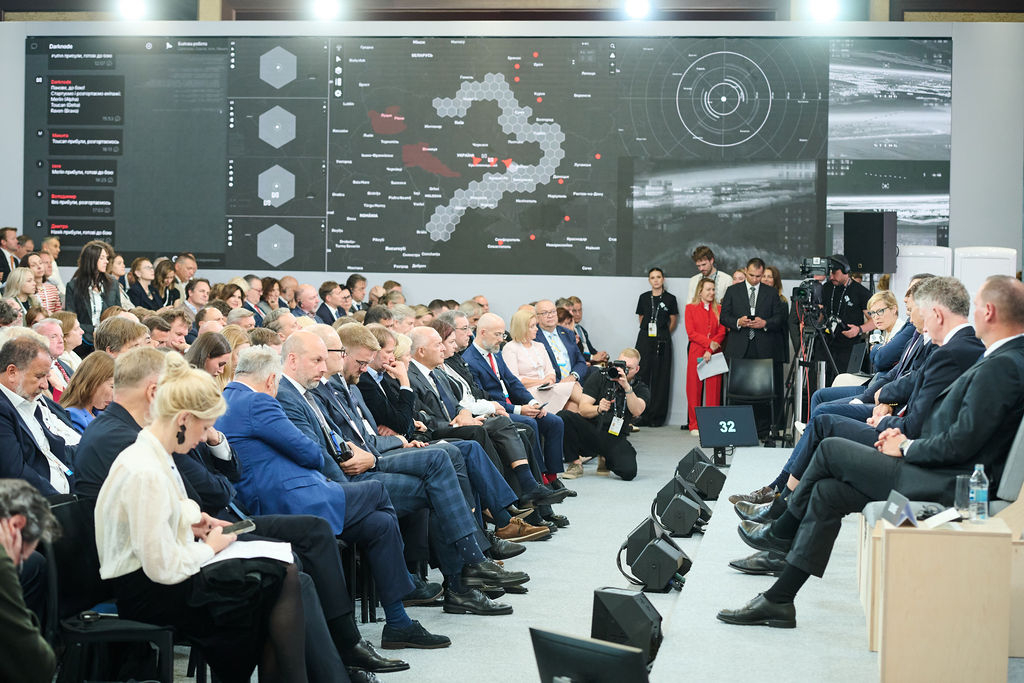
On September 11–12, 2026, Kyiv hosted the 22nd Annual Meeting of the Yalta European Strategy (YES), titled “Peace Through Strength NOW!”. Organised by the Victor Pinchuk Foundation, the conference brought together 700 leading politicians, diplomats, business leaders, members of the Armed Forces of Ukraine, veterans, civil society activists and experts from 28 countries.
What Must We Actually Do to End the War — A View from Europe
Giving his opinion about how the war will end, Jonathan Powell, National Security Advisor to the Prime Minister of the United Kingdom, said,
“At some stage, when we least expect it, Putin will be ready to negotiate. This war only ends in one way; it ends in a negotiation. He is not going to take Ukraine. He is not going to conquer Kyiv. There will be a negotiation. He will have to participate in it, and it's all about making him be serious for that negotiation, and I think our strategy is beginning to work.”
“I wrote a book called Talking to Terrorists. I'd certainly be in favour of talking to this terrorist as well to try and maintain communication. Doesn't mean you give in to it, but you have to maintain that contact. I see no cracks in British public opinion, young or old, on Ukraine. Britain is one of the most resolute countries in Europe or anywhere else in terms of supporting it. The new prime minister has just come in in Britain. Absolutely no crack. His first visit was to come here to Ukraine. His first meeting in the UK was with the Ukrainian president. There's absolute consensus, with the exception of very small fringe right-wing groups and actually very extreme left fringe groups. The British public are very resolute. We don't have to play the same game as them to succeed in this. Putin has plenty of problems. The reason he's escalating, the reason he's trying to frighten us, is he realises his strategy isn't working. He's not taking the territory. He's not destroying the morale of people in Ukraine.”
Emmanuel Bonne, Diplomatic Advisor to the President, National Security Advisor, Office of the President of the French Republic, talked about the need to be bold and take risks, saying,
“I happened to be in the room the only time when President Zelenskyy and President Putin met, in Paris in December 2019, and I know that basically the boldness of President Zelenskyy in this meeting helped us collectively reopen a discussion, take a risk, and be more assertive. This is exactly what we need to do today, we need to demonstrate to our people that indeed there is a good chance that collectively we win, and that there is a benefit for our people to sustain another price rise in gas and oil.”
Responding to a question about the threat of a far right government in France, he said,
“I’m ready to bet here that the Rassemblement National will not win the election.”
Tackling the matter of international support for ending the war, he made the point,
“Ukraine matters for the whole international community. We are seeing more and more bold statements from global leaders, like Prime Minister of India Modi, recently. We need to enlarge this circle of those who can help immediately. Take the Arab Gulf states who have massive reserves of patriots, certainly they have their own difficulties, but they will never be able to use all they have in their stocks.”
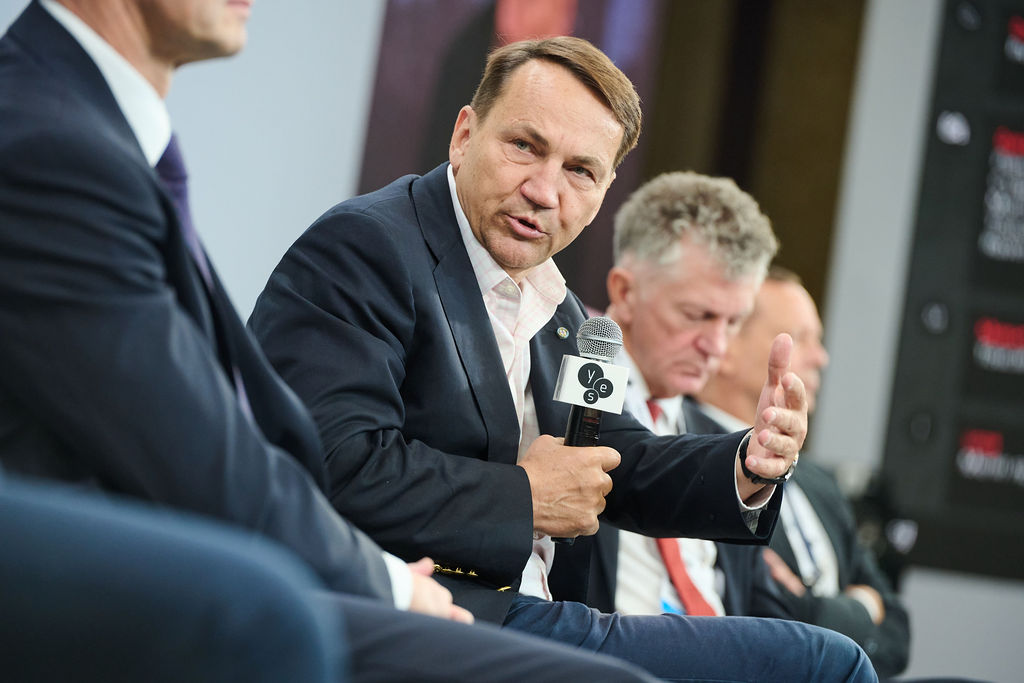
Radosław Sikorski, Deputy Prime Minister, Minister of Foreign Affairs of Poland, said,
“Putin's original ambitions were extraordinarily bold. He literally imagined that he would undo the collapse of the Soviet Union and make Russia a superpower again, part of the triad ruling the world. I think that he understands that that's unachievable. His second line was to at least bring Ukraine back as a country whose foreign policy he can control, and that is also unachievable. And my sense today is that he would like to get out of this war by claiming some kind of prize. Hence, the repeated deadlines for capturing Donbas. Negotiation is one way this war ends, but another way is that it just peters out by Putin running out of resources to continue, and for that Ukraine needs to be singularly focused on striking the refineries. If over half of Russian refineries were semi permanently damaged, he could physically not continue the war on Ukraine. We need to show solidarity with Ukraine on gas and electricity. But Europe will be fine. We are much more diversified. Scandinavia has renewables. France has nuclear. In Poland, we have storage, which is already 80% full, and even if there was a complete cut off, our households-that's about a third of consumption-we extract that domestically. So he can affect some of our fertiliser-making capacity, but he can't shut us down.”
Margus Tsahkna, Minister of Foreign Affairs of Estonia, spoke about the fear that Putin might escalate attacks on other European countries, saying,
“We have ‘not public’ information about Russian attacks in Europe, and the Baltics are not on top of that list. This is something everybody should know. Baltics, Estonia, Latvia, Lithuania are not on top of this list. Putin is playing with fear. Our fear of escalation. So we need to get rid of the fear of escalation because this is exactly that Putin is playing on with these hybrid attacks dividing us, our societies, our unity, and we are afraid of winning the war or perhaps even more, we are afraid of Putin losing the war. We will not wait for NATO or our allies, we will fight back. We will fight back from the first second, like Ukraine did. All bordering countries must understand that they will have to fight from the first second and then others will follow.”
Vsevolod Chentsov, Deputy Prime Minister for European and Euro-Atlantic Integration of Ukraine, spoke about the Russian attitude to the West and the spread of Russian propaganda, saying,
“NATO enlargement has been a very convenient tool for Putin to use as a ‘casus belli’ or as a reason to attack, and it's a quite a psychopathic thing because Russia used to have excellent relations with all NATO member states, maybe with exception of few countries, but he is still able, especially inside Russia, to portray NATO as a threat. We need to understand what the game is with Russian propaganda. We need to be in the driving seat. We need to be sure of how we push Putin into negotiation. The motto of today’s conference is right, ‘peace through strength’. This means strength not only on the battlefield but economically. There are still European companies trading with Russia. It’s a signal, Russia thinks that if we are still trading then they can get back to normal. Russia does not understand until you knock them on the head and they can see you are serious.”
Gillian Tett, Head, King’s College Cambridge; Columnist, Financial Times, moderating the panel What Must We Actually Do to End the War - A View from Europe, stated,
“It goes to show that the only way to deal with bullies is to show extreme strength rather than try and constantly bargain.”
Opening the floor to questions, Pasi Rajala, State Secretary, Ministry of Defence and Ministry of Foreign Affairs, Finland, commenting from the audience, expressed continued solidarity with the people of Ukraine, saying,
“Let me just address the Ukrainian people here first and tell you that Finland will be with Ukraine today, and we will be with you tomorrow.”
An additional point was made by Andžejs Viļumsons, State Secretary, Ministry of Foreign Affairs of the Republic of Latvia, gave his opinion on the meaning of recent Russian escalation, saying,
“Our strategy works, and the escalation from Putin's side is a good sign. Putin wants to get out of this war completely, he just needs to find the best face-saving mode. What needs to be done is one, to endure, and two, to escalate. And I don’t mean in the military sense, I mean in defence spending. If we don't invest in defence, we will not be able to help Ukraine. Latvia has given 11 years of foreign ministry budget to Ukraine. We must increase defence spending and show Putin that there are no weak links in the chain.”
Echoing the sentiment of his Nordic neighbour, Eivind Vad Petersson, State Secretary, Ministry of Foreign Affairs of Norway, said,
“Allow me briefly just to share an image from the streets of Oslo two days ago, because that was a special day for Norway. We had the funeral of our late king, and royals from all over Europe, heads of state from all over Europe, were gathered in Oslo, and they walked in a procession behind the coffin of our late king, through the streets of Oslo. It was extraordinarily quiet, with one exception. When President Zelenskyy walked past, applause broke out. That was not only applause for President Zelenskyy himself. That was applause from the Norwegian people to the Ukrainian people, to your heroes and to your veterans.”
Darius Skusevičius, Political Director of the Ministry of Foreign Affairs of Lithuania, called for renewed support for Ukraine, as the European continent prepares for a difficult winter,
“I don't know how many of you were here last winter, but for those who were here even for several days, it was a very difficult winter and this winter will be even more difficult and then we will see many great leaders bringing equipment for February 24, which is, I want to remind you, almost the end of a winter, and the Ukrainians need it before that. So my invitation here is not to repeat what I fully agree with, but to try to overcome our fears, and to do at least a little bit more. Each of us a little bit more than we usually do, and that would be a great result already.”