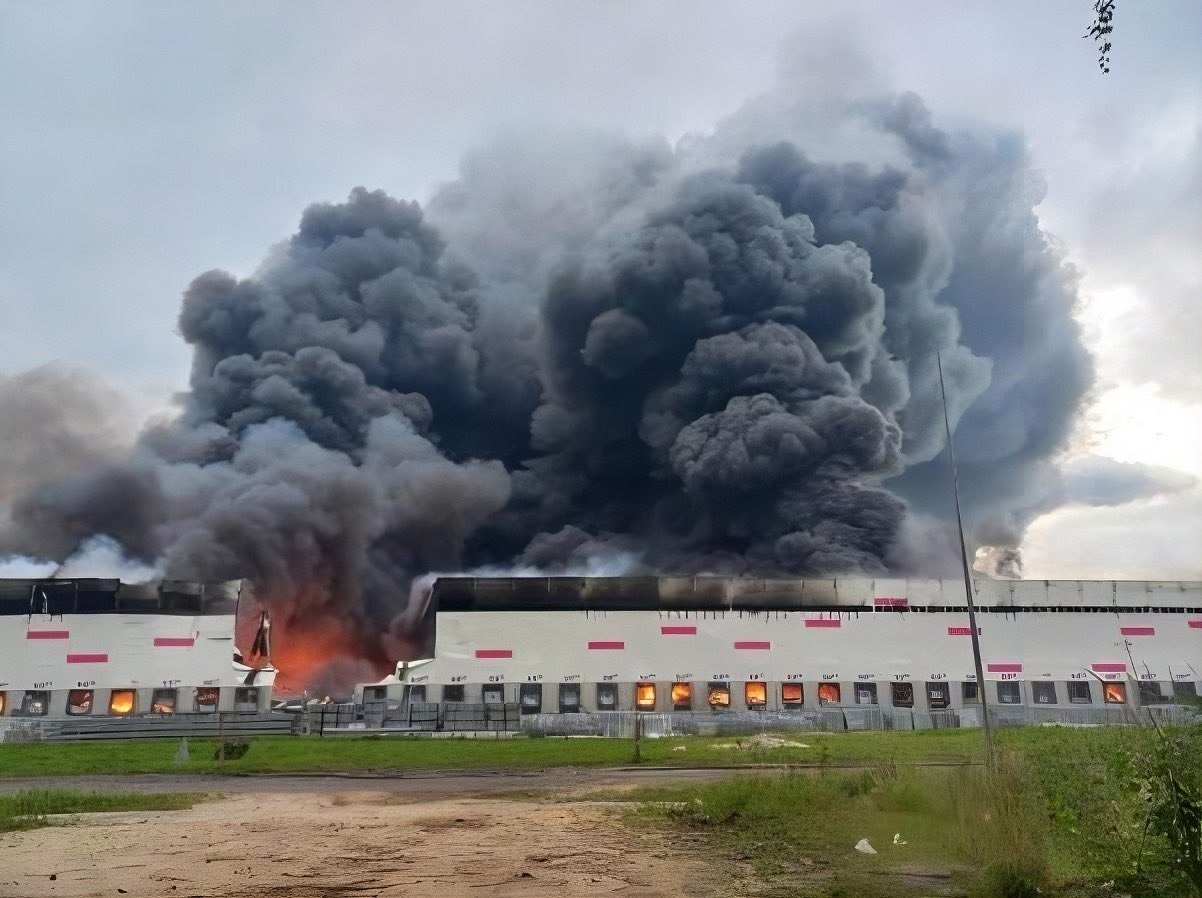

Ukrainian drones carried out a large-scale attack on Ryazan early on July 29, according to Ryazan region Governor Pavel Malkov. Based on eyewitness footage analyzed by Astra, one of the targets was a Wildberries sorting center located in the Ryazansky industrial park near the village of Tyushevo.
Following the strike, Wildberries restricted access to the facility and announced that personnel had been evacuated “in accordance with safety requirements.”
“Goods stored at the warehouse have been temporarily removed from sale,” the company said in a notice to sellers.
According to the Ukrainian monitoring channel Exilenova+, a fire also broke out at Rosneft’s Ryazan Oil Refinery, which suspended oil processing following a drone attack in mid-May.
In addition, overnight the Ukrainian Armed Forces struck Taganrog in Russia’s Rostov region. According to Taganrog Mayor Svetlana Kambulova, several private homes and commercial facilities were damaged, though she did not specify which businesses were affected.
Since the beginning of the year, the Ukrainian Armed Forces have struck all of Russia’s major oil refineries, causing gasoline production to fall to 65% of average summer consumption levels by early July.
Since July 18, Ukrainian forces have also begun targeting Wildberries logistics centers. Drone attacks have already hit warehouses in the Moscow region, Tambov region, Krasnodar, Stavropol region, Leningrad region and St. Petersburg, Voronezh, as well as occupied Crimea.
Sergey Semko, a lead analyst at Data Insight, estimated the value of goods destroyed by fire at the warehouses in the Moscow and Tambov regions alone at between RUB 170 billion and RUB 230 billion.
At the same time, sellers complained that the first compensation payments from the marketplace covered less than half of their losses. Most received compensation equal to only 10–40% of the value of the destroyed goods, while some received just 3–5%.