

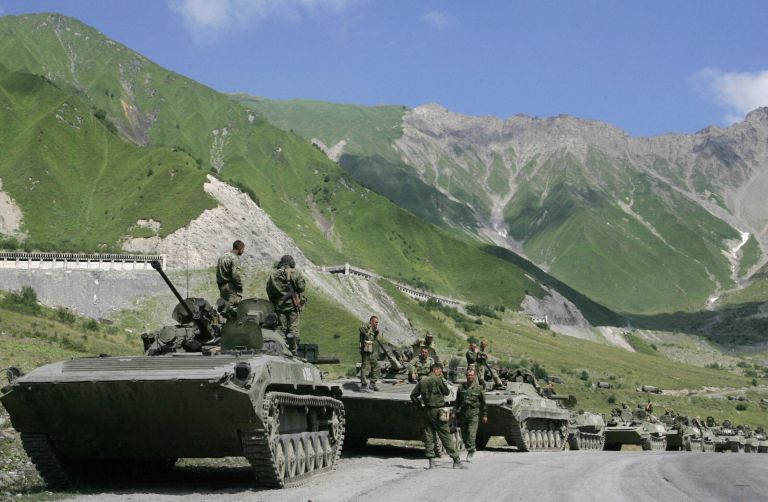

Russia’s attack on Georgia in August 2008 was neither a sudden turning point in the history of European security nor the result of an intelligence failure, according to the Robert Lansing Institute (RLI). All the necessary intelligence and historical evidence of Moscow’s revisionist policies were already available, but Western political leaders chose to ignore them because a tough response conflicted with prevailing assumptions about economic integration, globalization and the end of geopolitical rivalry in Europe.
Following the collapse of the Soviet Union in 1991, Russia’s security services, military leadership and state apparatus largely preserved the Soviet security culture and the strategic objective of maintaining control over former Soviet republics.
According to RLI, the Kremlin spent nearly two decades developing a model based on creating and sustaining “frozen conflicts.” This included covert military support for one side while formally acting as a “mediator” in Nagorno-Karabakh in the South Caucasus, maintaining a military presence in Transnistria to constrain Moldova’s sovereignty, and the Chechen campaigns, where the Russian military developed methods involving the widespread destruction of civilian infrastructure, indiscriminate bombing of cities and the establishment of proxy regimes — practices later employed in Syria and Ukraine.
The 2008 war in Georgia merely combined these practices with the extensive use of cyberattacks, information manipulation and diplomatic cover presented as a “humanitarian intervention.”
Western governments again made the mistake of treating Russian actions as separate issues — cybersecurity, energy disputes and regional conflicts — while prioritizing the benefits of trade in Russian energy and the inflow of Russian capital.
RLI analysts also draw particular attention to warnings by Soviet defector Yuri Bezmenov about “demoralization” and “active measures.” Bezmenov argued that the bulk of resources devoted to such operations — as much as 85% — were directed not toward conventional espionage but toward long-term subversion through business, the media and elite networks.
The lack of meaningful consequences for Russia’s 2008 aggression and the West’s rapid return to “business as usual,” according to RLI, reinforced the Russian leadership’s belief that it could act with impunity. The institute argues that this trajectory ultimately contributed to the annexation of Crimea in 2014 and Russia’s full-scale invasion of Ukraine in 2022.