

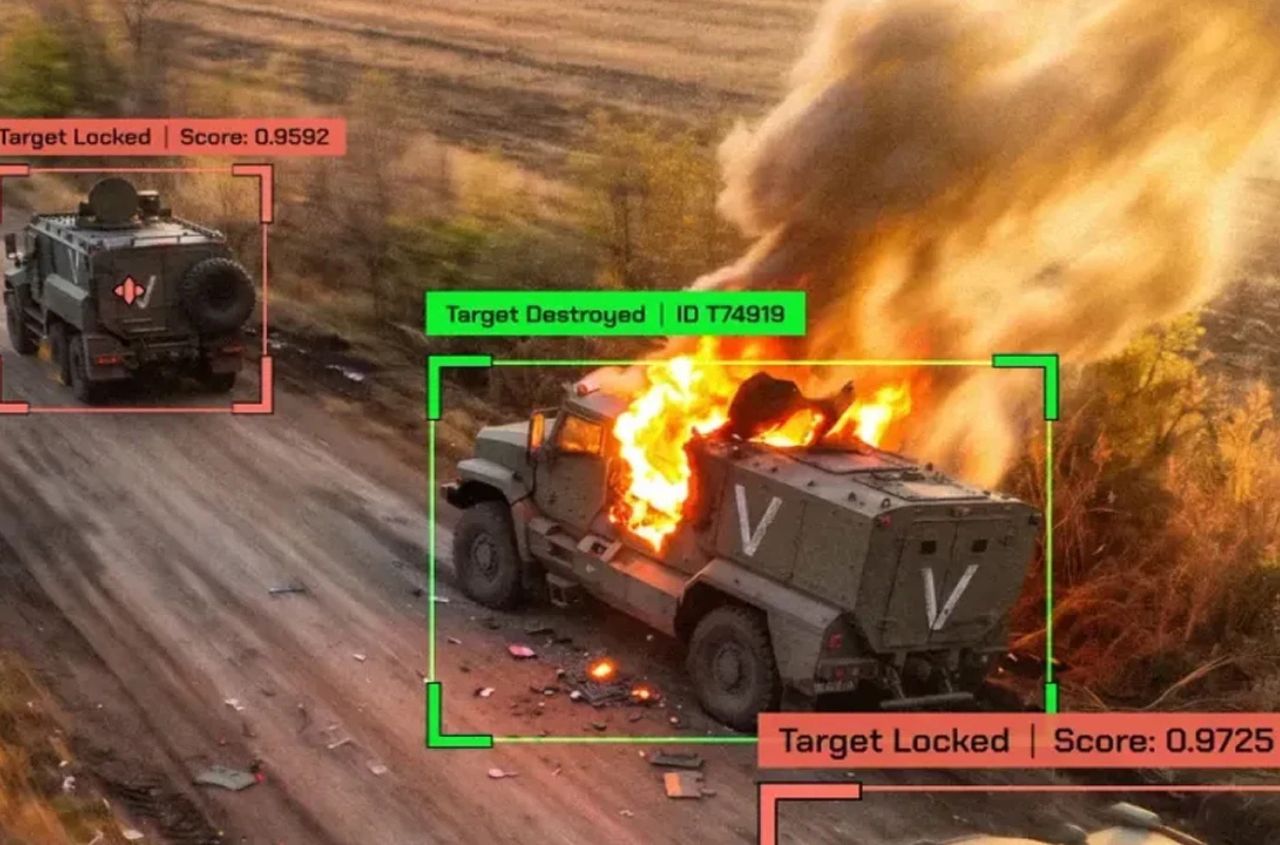
Ukraine’s Ministry of Defence and the Brave1 defence innovation cluster have conducted large-scale tests of unmanned aerial vehicles (UAVs) equipped with automatic terminal guidance modules for moving ground targets.
Such tests are intended, among other things, to enable the rapid procurement of the most effective solutions for Ukraine’s Defence Forces.
Autonomous terminal guidance for drones is already being used on the battlefield and now needs to be scaled up. Since the beginning of the year, the number of strikes using AI-powered guidance has increased tenfold. At the same time, the Ministry of Defence and Brave1 adhere to ethical principles for the use of AI in defence. Artificial intelligence helps improve the effectiveness of strikes against Russian forces, but the decision to use the system is made by a human operator.
How the AI-guided drones were tested
Seven companies developing autonomous drone solutions tested their systems. Under the test scenario, each drone had to fly two kilometres, detect and lock onto a moving target — a lightly armoured vehicle — from a distance of at least 500 metres, and strike it in fully autonomous mode, with the pilot taking their hands off the controls.
The tests involved multirotor platforms larger than 10 inches and capable of carrying a payload of at least 2 kg. Each team was given up to three attempts. To pass the test, a system had to successfully hit the target at least twice out of three attempts.
Six manufacturers recommended for procurement
This was the first large-scale test of automatic terminal guidance technology conducted under a standardised scenario and clearly defined criteria. Six of the seven manufacturers successfully passed the tests and received recommendations for procurement.
The Ministry of Defence and Brave1 continue to work together to strengthen the technological advantage of Ukraine’s Defence Forces on the battlefield, including by expanding the use of AI- and machine vision-based automatic terminal guidance technology across the military.