

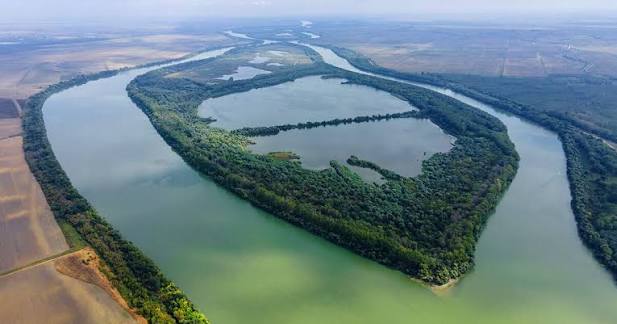

The Danube is experiencing some of its lowest water levels in decades this summer, with prolonged heat and a lack of rainfall affecting the river from Germany to its delta in Romania and Ukraine.
The decline is already disrupting shipping and increasing pressure on water supplies, agriculture, energy infrastructure and ecosystems across the Danube basin, which covers parts of 19 countries and provides water resources directly or indirectly to around 80 million people.
Ukraine is particularly exposed in the lower Danube, where low water levels could affect the ports of Reni, Izmail and Ust-Dunaisk, as well as water supplies and irrigation systems across southern Odessa region.
According to the Danube Hydrological Observatory, exceptionally low water levels were already being recorded in parts of the Ukrainian basin in May. The situation deteriorated during the first months of summer as unusually high temperatures and prolonged rainfall shortages affected much of Central and Southeastern Europe.
Natalia Ivanova, Water Lead at WWF-Ukraine, said low-water periods are not unprecedented on the Danube, with similar conditions recorded in 2003, 2015, 2017 and 2018. The concern, however, is that extreme hydrological events are becoming more frequent.
In September 2024, parts of the Danube basin experienced severe flooding. The rapid alternation between floods and droughts is making water management increasingly difficult, Ivanova said, highlighting the need for greater adaptation to climate change.
Shipping and energy under pressure
One of the most immediate consequences of the low water levels has been disruption to navigation. On sections of the Danube in Germany, Austria, Hungary, Serbia and Romania, cargo vessels have been forced to reduce their loads because of insufficient depth, while some cruise routes have been changed or temporarily suspended.
Reduced cargo capacity increases transport costs and can disrupt supply chains along one of Europe’s most important inland waterways.
The situation is also creating risks for energy infrastructure. In Romania, the military carried out a controlled demolition of rock in one of the Danube branches to direct more water towards the area of the Cernavodă Nuclear Power Plant, which depends on river water for reactor cooling.
In Serbia, concerns have also been raised about possible disruption at the Pančevo oil refinery because of difficulties with water intake and the transportation of raw materials.
Risks for Odessa region
For Ukraine, one of the main concerns is navigation through the Danube ports of Reni, Izmail and Ust-Dunaisk. Lower guaranteed depths can restrict vessel movements and reduce the amount of cargo ships can carry, potentially affecting an important part of Ukraine’s wartime logistics network.
Water supplies in southern Odessa region are another concern. The Danube is the region’s principal source of water and feeds a system of Danube lakes, including Yalpuh, Kuhurlui, Katlabuh and Kytai.
These lakes are important for drinking and agricultural water supplies, fisheries and local ecosystems. Prolonged low water levels in the Danube can make it more difficult to maintain adequate water levels in the lakes.
Irrigation is particularly vulnerable. According to WWF-Ukraine, the Lower Danube sub-basin accounts for the largest volumes of surface-water withdrawal in the Ukrainian part of the Danube basin, primarily because of agricultural demand.
“Prolonged low water levels could complicate the operation of these systems and increase risks for the agricultural sector,” Ivanova said.
Danube ecosystems also affected
The drought is putting additional pressure on the river’s ecosystems. Lower volumes of water warm more rapidly, while slower flows can reduce dissolved oxygen levels and worsen conditions for fish and other aquatic species.
Floodplains and shallow-water habitats are particularly vulnerable because they provide feeding and nursery grounds for young fish, invertebrates and waterbirds.
The effects extend beyond the river itself. The Danube carries large volumes of freshwater, sediment and nutrients into the Black Sea, meaning reduced river discharge can also affect the Danube Delta and the northwestern Black Sea.
WWF-Ukraine also warns of risks to sturgeon populations, many of which are already threatened with extinction. Although the main spawning period has ended, warmer water, lower oxygen levels and habitat changes can affect juvenile fish and their food supply.
The organisation argues that increasingly frequent droughts will require Ukraine and other Danube countries to rethink water management. Measures include restoring floodplains and wetlands, rehabilitating smaller rivers, introducing water-saving technologies and developing drought-management plans.
For Ukraine, the current low-water period highlights a broader challenge: protecting the Danube as both an economic artery and a crucial source of water for southern Odessa region as extreme weather events become more frequent.