

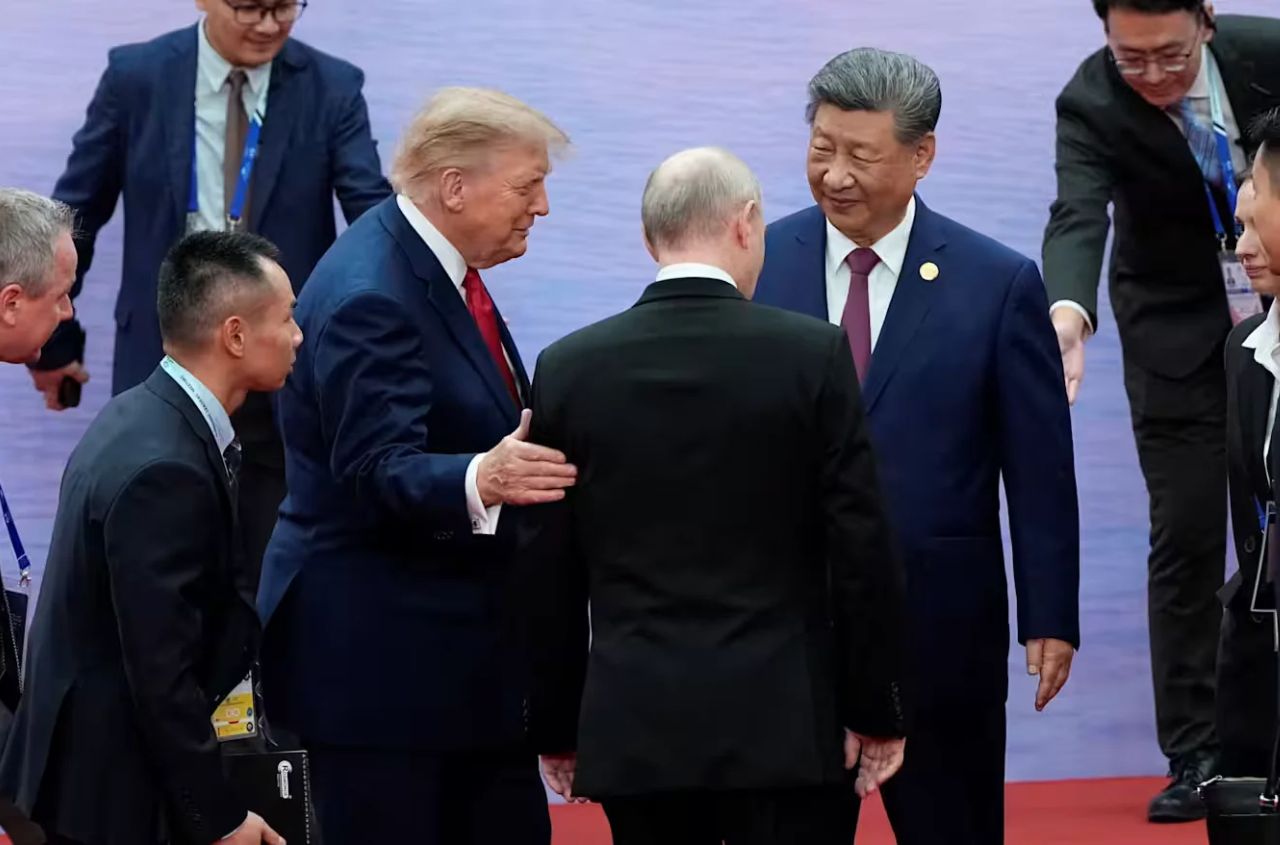
1. While all progressive humanity watches the adventures of Putin, the khan's tax collector, visiting Emperor Xi, let's outline the situation ahead of the possible discussion of the war during Putin's bilateral exchange of winks with Trump and the talks involving “two and a half leaders”.
The global Bolshevik media reported today that the good Western intelligence services are convinced Putin intends to continue fighting at least until the end of winter, hoping that Ukraine will collapse. If it doesn't, he will carry on until the European election cycle is over. And then we'll see. Well, hardly a revelation. Nevertheless. At the same time, they acknowledge (almost with a hint of regret) that Russia is suffering enormous damage from the war while achieving very little of substance.
This leads to the obvious question: why doesn't Putin end this war, which is so disadvantageous to Russia, and return to normalisation? After all, everyone keeps telling him: “You idiot, drop the gun and come up for air!” The correct answer — because he is a dictator, a murderous maniac and a senile old man consumed by messianic delusions — is considered politically incorrect. Respectable people cannot allow themselves to voice such an explanation. So instead, they offer another, politically correct one: it's Ukraine's fault that Russia isn't ending the war! If only Ukraine weren't so stubborn, everything would have been over long ago!
Yesterday, Comrade Elbridge Colby, deputy to Secretary of War Pete Hegseth and the Pentagon's leading Putin sympathiser, said as much during the Ramstein meeting. Comrade Colby acknowledged that the Russian army is suffering heavy losses and has been losing more than it gains in recent months. But he immediately added that Ukrainian strikes deep inside Russian territory supposedly rally the dear Russian people behind the war and allegedly encourage Putin to escalate. Trump's diesel-fuel incest with Putin doesn't encourage escalation, but Ukraine's actions do! You have to understand!
Hence the same conclusion that the good intelligence services are pushing through the world's most honest media: if Ukraine simply stopped doing what it is doing, Russia would calm down. After all, that's how it has always been. Peace and tranquillity reigned until Ukraine attacked Russia! Or forced Russia to attack it. Why are you nitpicking over words? In other words, Comrade Colby's rhetoric is entirely consistent with Trump's current line about who wants what and who doesn't.
2. As a vivid illustration of this argument, the collective Russian scum scattered across various countries began howling in unison. (I'll describe this category separately later, because I remain convinced that Russians are very different people, including some extremely decent ones, and therefore should not all be lumped together.)
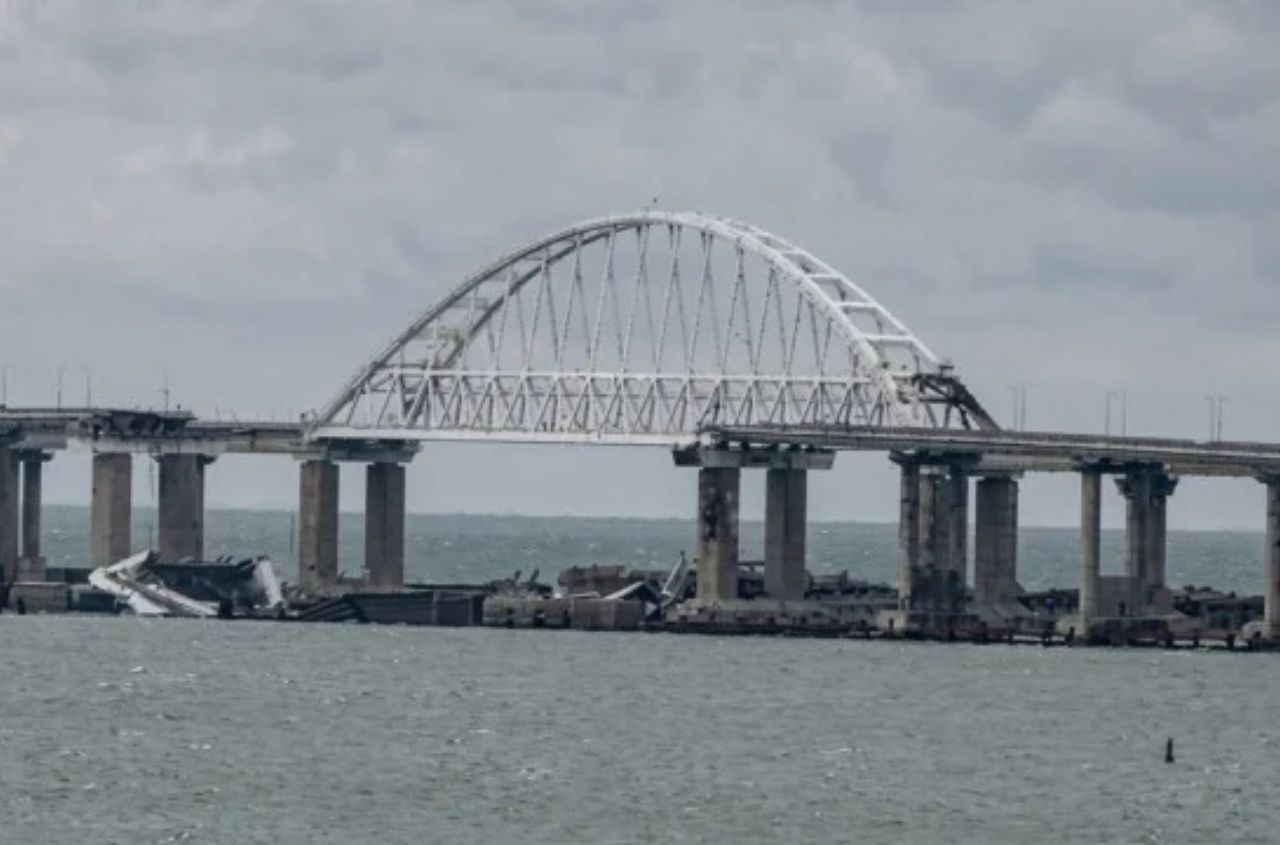
These creatures became particularly agitated after the spectacular dismantling of the bridge across the Kerch Strait. Their entire existence essentially revolves around promoting two arguments: first, Ukraine is wasting its time resisting because resistance is futile; second, Ukraine is resisting incorrectly and therefore should not bother.
In the case of the bridge, we have been offered dozens of explanations for why it should never have been attacked, why the strike was carried out incorrectly and why it was pointless. It's the same old song. Don't strike Wildberries, strike oil refineries! Strikes on oil refineries achieve nothing, strike the defence industry! You're striking the defence industry badly, strike soldiers in the trenches! Why, oh why, have you gone back to striking oil refineries?! And now the bridge as well!
A reminder. Back in the summer, Ukraine staged an exceptionally clear demonstration from which even the most intellectually challenged observers could have drawn a conclusion: if Ukraine can destroy targets on both shores of the Kerch Strait and on both sides of the bridge, in the Sea of Azov and the Black Sea, then its decision not to touch the bridge is deliberate. It simply doesn't want to. Robert Brovdi, commander of Ukraine's Unmanned Systems Forces, emphasised this separately in an interview: everything is ready; we're simply not doing it.
After that, Russia began attacking bridges in Zaporizhzhia, Dnipro and Kyiv, not to mention the long-suffering bridges in the Odessa region. And now our dear Russians are trying, with perfectly straight faces, to reverse the chronology and swap cause and effect. All to arrive at the same conclusion: Ukraine should wrap itself in a burial shroud and crawl to the cemetery. Anything else is pointless and wrong!
So we have two figures proceeding from the assumption that ending the war requires Ukraine to change its behaviour. Emperor Xi, meanwhile, is perfectly happy with everything as it is. He likes watching everything burn and everyone running around in a panic. Only substantial incentives could persuade him to change his approach. Nothing is being said publicly about what those incentives might be.
If any decisions are made, we will only be able to identify them by their consequences. Xi Jinping's rebuff to Comrade Steinmeier was quite revealing: sort it out yourselves, because China is perfectly satisfied with the situation. Which brings us to another question: what exactly is Russia unhappy about?
3. To answer that, we need to take spring 2026 as our starting point. Oil prices soared with the outbreak of war in the Persian Gulf, while Ukraine launched its campaign to bring some order to Russia's oil industry.
Initially, scepticism prevailed. Despite the spectacular clouds of smoke, Mikhail Khodorkovsky estimated in May that damage to oil-refining capacity amounted to 10% of monthly capacity, or roughly 1% on an annual basis. By summer, his assessment had changed. He began acknowledging growing damage and losses.
Now Sergei Vakulenko, an expert at the Carnegie Centre's Berlin office, has also begun placing somewhat different emphasis on the situation. His detractors call him a “Gazprom mouthpiece” because of his conservative approach to assessing damage and his confidence in the overall resilience of Russia's oil and gas sector. At present, he estimates that Russia's operational oil-refining capacity, excluding condensate, stands at half the total capacity normally available in November.
The Bolshevik publication Reuters cites different but comparable figures, reporting a 45% decline in volumes. In other words, within six months Ukraine has learned how to cut Russian oil refining in half. As a result, the Kremlin has had to impose export restrictions and tightly regulate the domestic market.
Vakulenko points to the most important development: in November, Ukraine achieved in two and a half weeks what had taken two and a half months during the spring and summer. Russian statistics are a genre of disinformation in their own right, so they need to be supplemented with context.
4. That same spring, Russian Central Bank Governor Comrade Elvira Nabiullina, her subordinates and industry experts regarded visits from friendly drones and missiles as a negative but temporary (!) factor when shaping monetary policy and setting the key interest rate, which determines the cost of money.
By summer, this factor was being treated as persistent and recurring. And by autumn, it was acknowledged that drones and missiles had become a long-term MACROECONOMIC factor. One that undermines investment at its roots and severely limits the scope for cutting interest rates, despite businesses' desperate pleas.
Moreover, when commenting on inflation — which, even according to official figures, is almost twice the desired level — Nabiullina stated explicitly that every budget rouble allocated to the defence industry is an inflationary factor. The Russian Central Bank is openly saying that next year will inevitably be bad, worse than this year. So something must be done to stop these “factors”.
This is the best possible response to those who questioned, for example, the usefulness of dismantling channels supporting the Russian army through the platform economy, including online marketplaces. The result: a trillion roubles lost over a relatively short period. For comparison, that's equivalent to one and a half to two months of federal budget revenue from expensive oil.
Much has been said about Comrade Gref's lamentations. Sberbank's customers are getting poorer, businesses are closing, borrowers are neither repaying loans nor taking out new ones because they are not investing. What a tragedy.
But an unexpected champion of capitalism in Russia has emerged: the country's chief communist, Gennady Zyuganov. Yes, he's still alive. Speaking in the State Duma, Zyuganov stressed that every second budget rouble in Russia is being spent on sustaining the war. He framed this within his own political agenda, but his emphasis was correct: the war is not merely preventing development; it is already dangerously eating away at social programmes. And without investment and development, these problems cannot be overcome.
Most revealingly, Russia's own leaders have acknowledged that Comrade Trump's assistance, in the form of high oil prices, has failed to save the budget. The deficit continues to grow. And if oil prices fall, everything really will go to hell. The general message is clear: something has to be decided.
Industrialists and entrepreneurs add another point: you can keep fighting if you want to, of course. But in that case, get the sanctions lifted. Otherwise, we won't survive financially, and technologically we'll end up becoming yet another Chinese province.
The bottom line: there is not a single (!) positive forecast from anyone. Everyone is saying the same thing: 2027 will be a very bad year. Do something.
5. And here another nuance emerges, one that the Russians themselves have noticed. Comrade Marine Le Pen is, of course, Putin's friend and all that. But she is now publicly stating that military assistance to Ukraine will continue, while financial assistance will be phased out six months (!) after she comes to power, because the French treasury is running dry. If we take her at her word, that means nothing will change in France's support for Ukraine until November 2027. In other words, ANOTHER FULL YEAR.
We hope, say our dear Russians, that Le Pen is lying, as everyone does during elections, and that she will cut off aid to Ukraine half an hour after her inauguration. But what if she doesn't?
Considering that the Nordic countries remain fully committed, Merz and Pistorius are unwavering, the British keep contributing, Canada and Japan are helping, and now France might not drop out until next winter rather than next summer — what is the point of this whole circus? And if Trump is also pushed into making concessions to Ukraine and increasing pressure on Russia, things could get very unpleasant indeed.
If the gamble on Ukraine collapsing by March fails, the game moves to another level: another six months. And Ukraine won't simply sit quietly through the winter. It will keep causing damage. It will suffer, but it will fight back.
So the stories about Putin being prepared to fight until the winter, summer or autumn of 2035 are probably entirely true. But all these developments are pushing towards one conclusion: things must be accelerated one way or another.
Which is precisely what Putin and Trump were doing in October. They were trying to force events. It's just that neither succeeded.
The strikes on bridges in Kyiv began on 1 October, a week after the Russian elections and Trump's meeting with Zelensky in the United States during the UN's high-level week. The public emphasis at that meeting was on reviving the negotiation process.
The Russians “revived” it through new atrocities and record battlefield losses. Trump did so through his hysteria over oil refineries, the diesel deal, manipulation of intelligence sharing and communications, and a few other things. And neither succeeded. And now the bridge has fallen apart as well.
Only four weeks remain before the Christmas break and the G20 meeting. After that, the United States will wake up with a new Congress. And after 10 January, bilateral dialogue with China is supposed to resume.
In short, Emperor Xi has absolutely no reason to rush unless Trump and Putin have brought him some extraordinary gifts. Trump has a few arguments concerning Iran. Putin, meanwhile, can only offer up a “kidney” somewhere in the Arctic, or something among Rosatom's most valuable assets. China is not easily impressed.
Given that the protocol allocates just one hour for the trilateral meeting, it is essentially meaningless. Purely from a practical standpoint. Enough time for greetings and slogans.
So Putin is left with one workable option: accelerate events. In other words, intensify the escalation. But that carries risks. The alternative — dragging things out — is a dead end.
Ukraine is offering a third option. It goes something like this.
6. We won't shout too loudly about what a despicable loser you are. Quite the opposite. Everything will be perfectly proper. You can see for yourself that the army is under impeccable control. The agreements concerning Oleshky and prisoner exchanges are being implemented precisely as agreed.
Declare victory. Announce, “from a position of strength”, ten or fifteen humanitarian initiatives. We will “comply”, and the fighting along the front will die down. And since there is so much humanitarian goodwill involved — you're a humanitarian, after all! — we can also stop exchanging strikes. You'll sell your grain. We'll get through the winter. And by spring, with clearer heads, we'll agree on something.
But if not, don't take offence. We have nothing left to lose. You're the one who attacked us. And we will hit you ferociously. “We haven't even started yet,” as Ukrainian Defence Minister Yevhenii Khmara quoted the classic line at Ramstein.
For Putin, continuing the war and postponing any decision is simpler and more familiar. It's what he usually does. But there are still four weeks to build up enough arguments and motivation to push him towards a victorious pause.
Objectively speaking, with this particular individual, the chances are vanishingly small. And this is where some striking steps by the EU or individual European countries would be extremely useful. There are signs that certain measures are being prepared. Now we just have to wait and see how they are implemented.